Intro: AI agent infrastructure context
AI agent infrastructure context is the missing piece that explains why a capable model can still fumble a simple server restart. The model may know how to call an API, but it does not know which VPS belongs to which customer, which cPanel account shares a PHP-FPM pool, or whether a DNS record is managed in Cloudflare or Route 53. The New Stack calls this gap the API tax: every action becomes a discovery call, then a retry, then another token spent explaining the failure. Their piece, The API tax: Why AI agents stall without infrastructure context (opens in new tab), frames the problem well. I have seen the same pattern on my own hosting boxes.
A site owner recognizes the shape of this problem from support tickets. Imagine a WordPress site returns a 503. An autonomous agent is told to fix it. Without infrastructure context, the agent starts by calling a generic monitoring API. It learns the server is up. Then it calls the web server API. It sees Nginx is running. Then it tries to restart PHP-FPM, but the box uses cPanel with CageFS, and the PHP-FPM pool is tied to a specific user. The restart command fails because the agent did not know the account name, the PHP version, or the fact that the customer has a staging copy on the same IP. Each failed guess costs latency, API quota, and model tokens. A human operator with context would have checked three things and fixed it. The agent burns twenty calls and still asks for help.
That overhead is the API tax. It is not a pricing line item from AWS or OpenAI. It is the accumulated cost of asking an agent to act without a reliable map of the infrastructure it is allowed to touch. Context here is not a longer prompt. It is a structured record of resources, ownership, recent changes, permissions, and safe actions. I do not think most teams have this layer today. They have tool calls and hope.
The practical question for anyone running self-hosted AI agents is where that context lives. A context window is temporary. Infrastructure context should outlive the conversation. More on that in the next section.
Background: Where the API tax comes from
The API tax grows out of a mismatch between how agents are built and how infrastructure actually behaves. Agents are good at following a tool schema. Infrastructure is full of state that does not fit neatly into a schema. A cloud API will tell you a VM exists, but not that it belongs to a customer who opened a billing dispute yesterday. It will tell you a DNS record changed, but not that the change was part of a migration window. The agent then spends calls to reconstruct what a human already knows from tickets, comments, and runbooks.
The New Stack’s article on this problem, The API tax: Why AI agents stall without infrastructure context (opens in new tab), frames the missing piece as a context layer. I agree with the framing, though I think the tax shows up earlier than most teams notice. It starts with discovery. An agent asked to scale a web tier will call a load balancer API, then an autoscaling API, then a metrics API, then an IAM API to check permissions. Each call returns a fragment. The model has to hold those fragments in its context window and reason across them. If one call fails with a throttling error, the agent retries, and the tax compounds.
On my own boxes, I see this with cPanel and WHM. A customer opens a ticket because their email is bouncing. An agent with raw WHM API access can list accounts, check quotas, read exim logs, and query DNS. That is four or five calls before it even knows whether the problem is a full mailbox, a blacklisted IP, or a misconfigured MX record. A human support tech with context opens one screen and sees the account is over quota and the MX record points to an old host. The gap is not intelligence. The gap is that the agent has to pay for every fact it lacks.
Managed agents from cloud providers hide some of this cost, but they do not remove it. They simply move the context into the provider’s platform. Self-hosted AI agents do not get that luxury. Their operators have to build the context layer themselves, often from Terraform state, monitoring labels, and billing exports. That work is unglamorous, and it is where the tax either shrinks or grows.
What’s happening now: autonomous cloud agents meet real systems
The pattern I see in production is direct API calls with no shared memory between them. An autonomous cloud agent gets a task like “right-size the staging cluster.” It calls AWS DescribeInstances to list instances, CloudWatch GetMetricData for CPU, the pricing API for on-demand rates, and the Cost Explorer API for last month’s spend. Each response lands in the context window as text. The model then writes a recommendation. If the agent needs to act, it calls the autoscaling API and then the IAM API to verify the role. That is six calls for a decision a human SRE makes after opening one dashboard and reading a Terraform plan.
The missing piece is not another tool wrapper. It is a durable infrastructure context layer that holds inventory, ownership, recent changes, and guardrails outside the context window. The New Stack piece (https://thenewstack.io/autonomous-cloud-context-layer/) makes this point about autonomous cloud systems, and my own tickets confirm it. I run a small VPS business on cPanel and WHM. When a customer reports a database connection error, a raw agent will call WHM API 1.0 to list accounts, UAPI to check the MySQL user, the disk quota API, and the DNS zone API. Four calls, four chances to hit a rate limit or return a stale result.
Generic tool interfaces make this worse because they expose verbs without state. “restart_server” looks simple until the agent needs to know whether the server is a production database, a staging web node, or a customer’s VPS that is already past due. Terraform state files show drift. VPS billing events show suspensions. cPanel limits show mailbox quotas. None of that is in the tool schema. The agent has to ask the provider API again, paying the AI agent tool call overhead in tokens and latency for facts the operator already has.
Cloud providers are shipping agent toolkits, and some of them are useful. What they mostly provide is authenticated access to actions. They do not provide a portable context layer that says this resource belongs to this customer, this change happened yesterday, this budget is nearly exhausted, and this action requires a human approval. So the agent keeps calling APIs to reconstruct a world that the infrastructure platform could describe once. That is the tax in its current form. It is not a model failure. It is a context failure.
What it means in practice: building an AI agent infrastructure context layer
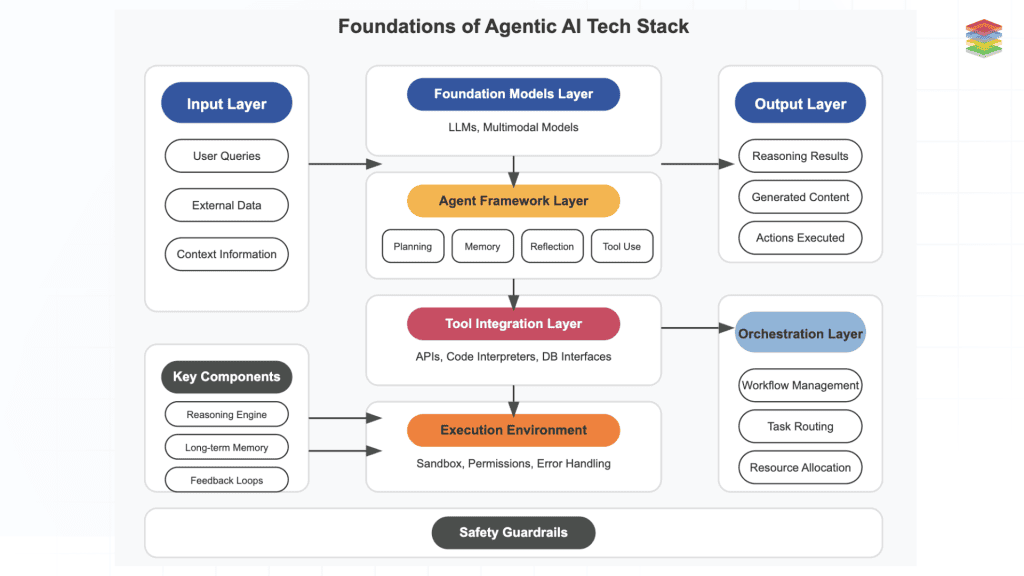
AI agent infrastructure context is the missing piece that lets an autonomous system act without paying a tax on every call. It is a structured record that an agent can read before it invokes a provider, containing the resource identifiers, ownership, recent changes, budget limits, and the approval rules that apply. When this record exists, the agent can decide whether to query the API directly or to use a cached value, cutting down the number of round trips and the tokens spent on retries.
A concrete analogy is a shopkeeper who keeps a paper inventory sheet. Instead of walking to the back room each time a customer asks about stock, the clerk glances at the sheet, sees the quantity, and only goes to the storeroom if the sheet shows a low count. In the same way, an AI agent can consult a local JSON file that lists each VPS, its owner, its current state, and the last known change. If the file says the server is running, the agent can skip the API call to check status, saving latency and avoiding rate‑limit errors.
The practical components are straightforward. First, capture a normalized inventory of every resource the agent may touch, including IDs, tags, and cost centers. Second, record identity and permission data, such as which IAM role or cPanel user is allowed to restart a service. Third, store a change log that notes when a Terraform plan was applied or a billing event occurred. Fourth, attach budget guardrails that flag actions exceeding a daily spend threshold. These pieces can live in a simple database, a set of YAML files, or a dedicated microservice that the agent queries through a local endpoint. The API tax: Why AI agents stall without infrastructure context (opens in new tab) explains why this layer is becoming essential for autonomous cloud systems.
I expect that over the next year more teams will adopt a lightweight context store as a standard layer between agents and cloud APIs, because the cost of not doing so becomes visible in every invoice. The forward‑looking step is to start today: create a small inventory file for the resources you manage, define the fields that matter for your workflows, and expose it to your agent through a read‑only endpoint. That single file will let the agent answer most routine questions without hitting the provider API, and it gives you a foundation to expand the context layer as your systems grow.