2.3 quadrillion requests, and the week that pulled the other way
Amazon ElastiCache peaked at 2.3 quadrillion daily requests during Prime Day this year. That is the figure that sits at the top of the AWS Prime Day 2026 by the numbers post (opens in new tab) published on October 13, and it is the one that resists being pictured. Divide it across 86,400 seconds and you land somewhere near 26 billion requests per second held through the peak. Because this is a cache tier, nearly all of those are answered out of memory rather than off a disk, which is the only reason a number that size is survivable at all.
The busiest VPS I run serves about 500 requests per second when it is having a good day. Matching ElastiCache’s daily average would take roughly 53 million machines doing that at once. Not 53 million cores or containers. Fifty-three million separate boxes, each one a machine an operator has to patch. That is the closest I can get to a shape I recognise, and the shape is still absurd.
Prime Day itself ran in June, so this retrospective lands four months late by design. What is left of the event in October is the absence of evidence. No postmortem, no status page history, no 3 a.m. page for anyone outside Amazon. Tens of trillions of DynamoDB requests and more than 2.3 trillion Lambda invocations per day happened, and then stopped being news.
The same week pushed hard in the other direction. Claude Haiku 5.5 arrived on Bedrock at roughly 75 percent below Haiku 4.5, with effort controls that let you dial cost against capability per task. Nova 2.5 Sonic brought faster speech-to-speech voice agents. Strands Bidi Agents went generally available. GuardDuty RDS Protection started reading queries rather than only logins, and Lambda Kafka event source mappings finally accepted OAuth. Cheaper, narrower, more constrained tools, all released in the shadow of a record.
That contrast is the part I find more interesting than the peak. Capacity climbing while the surrounding tooling gets smaller and more disciplined usually means the easy efficiency wins are gone and the platform is being squeezed from both ends.
The peak figures deserve a closer read too, because at least two of them get quoted for things they do not actually measure.
Background: how AWS Prime Day 2026 by the numbers reached this scale
AWS has been publishing Prime Day metrics since 2016, and the value of the tradition is the year-over-year line rather than any one figure. The roundup post (opens in new tab) collects all of this year’s numbers in one place, which makes it easier to see which ones are actually moving.
Start with DynamoDB, because it is the one people misread. Over the four days, DynamoDB processed more than 59 trillion requests and peaked at 192 million requests per second, holding single-digit millisecond responses the whole way. Divide 59 trillion across four days and you get roughly 171 million requests per second as a sustained average. The published peak sits only about 12 percent above that average. That is not a spike you survive with a warm fleet and a prayer, it is a plateau you live on for four days straight. Most of us plan for the spike shape and never see the plateau shape.
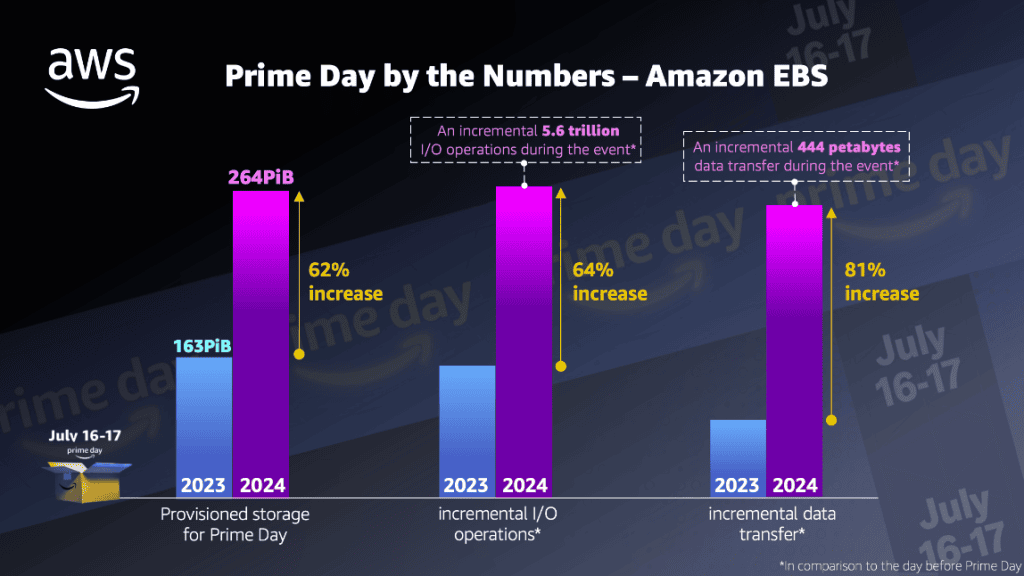
The surrounding figures follow the same pattern. Lambda handled more than 2.3 trillion invocations per day. EBS peaked above 24.8 trillion I/O operations while moving more than an exabyte of data daily. None of those numbers describe burst capacity. They describe a system that was already running near the top of its range before the sale started.
The compute mix is where the interesting movement is. Amazon ECS launched an average of 158.3 million tasks per day on Fargate, up 47.7 percent over last year, which is a large jump for a platform Amazon.com already depends on heavily. Meanwhile Graviton carried up to 49 percent of the EC2 compute Amazon.com used during the event. Close to half, and still climbing, but not a majority yet.
For anyone running their own infrastructure, there is a recognisable shape in that split. Fargate task count going up almost 48 percent in a year is what happens when a team stops provisioning instances by hand and lets the scheduler do it. I have watched that same transition turn a capacity spreadsheet into something nobody opens anymore. The Graviton share is the slower, less visible half of the same efficiency push, and it is the one I would watch next year.
What’s happening now
The same week those peak figures went out, the launch list went the opposite direction. Smaller models, tighter scope, more constraints. Claude Haiku 5.5 (opens in new tab) landed on Amazon Bedrock at around 75 percent less than Haiku 4.5 for most tasks, and it is the first Haiku with effort controls. That second part matters more than the discount. Instead of picking one reasoning setting and paying for it across every call, you can dial effort per task. A routing decision that needs three tokens of thought no longer carries the cost of a task that needs thirty.
The pairing AWS keeps pointing at is Opus 5.5 doing the planning and judgment calls while parallel Haiku subagents handle routing, classification, and small edits across many files. I have run classification jobs where the per-call cost was the only thing keeping me from splitting them into finer-grained subtasks. Dropping the unit price by roughly three quarters changes which architectures are even worth considering.
Voice got a quieter update. Nova 2.5 Sonic is a speech-to-speech model with better tool-calling accuracy, lower latency, a 256K context window, and voices in seven languages, plus controllable turn taking. It ships alongside Strands Bidi Agents, now generally available, so the plumbing between a voice stream and an agent loop is mostly handled. A support agent can look up an order, check return eligibility, and start the return inside one conversation rather than handing the caller to a second system.
Two releases will matter to teams with auditors. GuardDuty RDS Protection now builds behavioral baselines over the queries themselves on Aurora PostgreSQL and RDS for PostgreSQL, not just the login events, with no agents or database configuration changes required. And Lambda event source mappings for self-managed Apache Kafka now support OAuth through an identity provider like Cognito or Okta. Before this, Kafka ESM supported only SASL/PLAIN, SASL/SCRAM, and mTLS, which shut out teams whose security policy requires centralized identity for every consumer. That is a specific, unglamorous unblock, and I would guess it frees more deployments than the model releases do.
AWS Prime Day 2026 by the numbers: the questions readers keep asking
Q: Did AWS actually publish a requests-per-second figure this year?
Yes. DynamoDB peaked at 192 million requests per second across the four days and held single-digit millisecond response times the whole way through. That number is worth sitting with, because peak RPS is the harder claim. A trillion requests spread over a week is a throughput story, and throughput is mostly a provisioning problem. Sustained 192 million per second is a different kind of problem, since every one of those calls has to find a partition, a replica set, and a return path within milliseconds, and any hot partition turns into visible latency for a paying customer.
Q: What is the 2.3 quadrillion number attached to?
Amazon ElastiCache. That is its peak daily request count during the event, not DynamoDB and not Lambda. I have seen this one get attributed incorrectly in a few threads, which is understandable given how the figures get stacked in a single paragraph. Lambda’s number is separate: over 2.3 trillion invocations per day. Same digits, three orders of magnitude apart, which is exactly the sort of detail that gets lost when a headline is written from memory.
Q: What is the real signal in these numbers?
The 44,000-plus AWS Fault Injection Service experiments run before the event, more than six times the 2025 count. Every throughput record in that roundup is downstream of that practice. Deliberate failure injection is how a team learns in March what would have broken in June, and it explains why none of the trillions of requests turned into a customer-facing incident. The AWS Weekly Roundup (opens in new tab) treats it as the punchline, and it is the number I would copy first.
Q: Does the Graviton share mean Amazon.com runs mostly on Arm now?
No. Up to 49 percent of the EC2 compute Amazon.com used, so it is close to half and still climbing, not a majority. Anyone quoting it as “mostly Graviton” is rounding in the wrong direction.
What it means in practice
The 44,000 FIS experiments are the part I would copy before any of the throughput records. Autoscaling gets the attention, and it does the work once traffic arrives, but it tells you nothing about what happens when a dependency goes quiet or a zone stops answering. Injecting a failed Aurora failover, or cutting a Lambda function off from its VPC endpoint, is how you find out in March that your retry logic has no jitter and will hammer a recovering service the moment it comes back. The cost is a few engineer-days. The alternative is discovering it at 2 a.m. on the busiest four days of your year.
Cost is moving in two directions at once, and it is worth being honest about that. Haiku 5.5 at roughly 75 percent below Haiku 4.5 cuts the spend per classification or routing task, and if you fan out to many subagents, that compounds fast. Against that, ECS launching 158.3 million Fargate tasks a day, up 47.7 percent, is a reminder that the compute underneath keeps growing. Cheaper tokens do not shrink your invoice if you answer by running more of everything. I have watched that trade play out on my own setups: a model swap that saved real money in month one, then a queue of new jobs by month three that ate the savings back.
For the Kafka work, OAuth support for self-managed event sources matters more than the release note suggests. Plenty of teams could not use Lambda’s managed scaling and batching at all because their identity policy banned SASL/PLAIN and mTLS did not fit their certificate rotation. Now the event source mapping can authenticate through Cognito or Okta the same way everything else does. In a regulated shop, that is the difference between a service you can ship this quarter and a design review you argue about for six months.
GuardDuty RDS Protection for data activity closes a gap I have seen described in postmortems more times than I can count. Once someone holds valid credentials, from a phish or a leaked key in a repo, their reads look like your application’s reads. Alerting on logins catches the break-in, not the browsing that follows it. Baselining the queries themselves is the part that catches the person who is already inside.
What to expect next
Three of the published figures carry the most forward weight: DynamoDB’s 192 million requests per second peak, Lambda at 2.3 trillion daily invocations, and the up to 49 percent Graviton share on the EC2 compute Amazon.com used. None of them have an obvious ceiling. Graviton has the clearest room to climb, and I expect the next round of numbers to push past 49 percent. Whether “up to 49” becomes a majority is a question of how much of the remaining estate is still pinned to x86 for reasons that have nothing to do with price.
Effort controls are the piece I would watch on the model side. Haiku 5.5 is the first Haiku that exposes them, and if that dial spreads across the rest of the Bedrock family, the way teams plan agent budgets changes shape. Right now you pick a model and live with its cost per call. If every model lets you trade cost against intelligence per task, you start budgeting per task instead, choosing a lower effort for a routing call and a higher one for a judgment call inside the same workflow. That is a different kind of planning, and I think it makes multi-agent designs cheaper to reason about than they are today.
The Fault Injection Service count is the one I have the least confidence about. AWS ran more than 44,000 experiments before Prime Day, more than six times the 2025 figure, and publishing that number turns it into a benchmark. Benchmarks invite imitation, so I would not be surprised if other large shops start reporting their own counts. That could go two ways. Either the practice spreads because the number is out there, or it turns into a number people inflate and stop learning from. I do not know which.
Speech-to-speech looks like it is folding into the standard agent stack rather than staying a separate product track. Nova 2.5 Sonic with a 256K context window, seven languages, and controllable turn taking, paired with Strands Bidi Agents now generally available, points at voice becoming a default interface for the same agents you already build. I do not know how that holds up for low-bandwidth users or for languages outside the seven.
re:Invent is close, so some of this will be superseded within weeks anyway.
Closing: pick one of these and test it on your own workload
Every figure from Prime Day belongs to somebody else’s peak. The 192 million requests per second DynamoDB held, the 158.3 million Fargate tasks per day, the 44,000 Fault Injection Service experiments none of it says anything about your stack until you map one of those practices onto a path you actually own. The useful move here is to take the smallest version of one item and run it this month, while the numbers are still fresh enough to compare against.
Start with a single FIS experiment on your highest-traffic path. Kill one dependency, and I would not pick the database for a first attempt. Choose something one layer out: an availability zone, a downstream API, a cache node. Then compare what your monitoring showed against what you assumed when you drew the architecture. I have run this twice on infrastructure I manage and was wrong both times about how far the failure spread. The second time, a retry loop nobody had documented turned a single node loss into a queue backlog that took forty minutes to drain. Fault injection gives you that answer inside a maintenance window rather than at 2am on your busiest day of the year.
If you already run Claude Haiku 4.5 for classification or routing, the second option costs an afternoon and a spreadsheet. Haiku 5.5 on Amazon Bedrock sits at roughly 75 percent less than Haiku 4.5 for most tasks, and it is the first Haiku with effort controls, so you can lower effort on the routing calls and raise it only where judgment matters. Price your busiest classification job at the new rate before you touch a single prompt. If the volume is high enough that the figure moves your monthly bill, test the migration on a shadow copy of the traffic. If it is not, leave it alone and spend the afternoon on the FIS experiment instead.
The Kafka work is for a narrower group. If your team runs self-managed Kafka consumers and could not adopt Lambda event source mappings because you needed enterprise identity rather than SASL/PLAIN, OAuth through Cognito or Okta removes that blocker. Wire up a mapping against a staging cluster and measure latency before moving production traffic, since automatic scaling and batching only pay off if the extra hop does not eat the gain.
Whichever you pick, write down what surprised you. That note will be worth more next June than anything AWS publishes in October.