Introduction
Moving self-hosted models from static research notebooks into multi-tenant production fleets breaks standard deployment patterns in ways that surprise many engineering teams. I spend my days managing infrastructure and running my own small hosting business, so I know how quickly a cluster degrades when you start mixing unpredictable workloads onto the same metal. When you build out a modern kubernetes ai stack, you quickly discover that standard stateless HTTP assumptions do not hold up when your application maintains massive tensor states in memory.
The shift toward domain-specific open weights changes infrastructure requirements entirely. Engineering teams are moving away from generic black-box API calls because their actual competitive advantage lives in proprietary data and specialized models, such as fine-tuning the Gemma family for legal document review or scientific analysis. But treating an expensive hardware accelerator like a standard CPU worker pool creates immediate operational pain. Traditional microservices expect short-lived requests, predictable memory footprints, and simple horizontal autoscaling. Large language models and reinforcement learning loops demand persistent accelerator allocation, heavy inter-node communication, and precise cache management.
When you try to run bespoke Ray or Slurm clusters alongside your existing orchestration tools, you fragment your infrastructure capacity and multiply your maintenance toil. You end up with siloed hardware pools that sit idle during off-peak hours while your web workloads fight for resources elsewhere. Scaling reinforcement learning post-training, stateful distributed inference, and autonomous agent execution requires a unified control plane. You need to manage your infrastructure without forcing your ML researchers to become Kubernetes experts or your platform engineers to manually debug PyTorch distributed communication errors at two in the morning. Google recently detailed this exact evolution in their architectural overview of the open AI-native stack on Kubernetes, highlighting how open-source projects are finally catching up to the operational reality of running production models.
Background on the kubernetes ai stack
Container orchestration spent the last decade conquering stateless web apps and traditional microservices. You pack a binary into a container, set an environment variable, define a liveness probe, and let the scheduler sort out the placement. If a pod dies, Kubernetes spins up another one on a different node in a few seconds. That model breaks down the moment you introduce stateful, accelerator-heavy workloads. A modern AI workload does not care about your graceful termination periods when it is holding fifty gigabytes of model weights in VRAM and executing a distributed all-reduce operation across an InfiniBand fabric.
Treating GPUs and TPUs like standard CPU worker pools is an expensive mistake. When you drop a high-end accelerator into a generic node pool without proper topology awareness, your distributed training jobs suffer from severe non-uniform memory access penalties and inter-node network bottlenecks. You end up wasting fifty percent of your compute capacity simply waiting for gradient synchronization to cross slow virtual switches. This is why many engineering teams historically bypassed their container platforms entirely. They built bespoke Ray or Slurm clusters alongside their main infrastructure, creating isolated silos that required dedicated maintenance, separate authentication systems, and manual capacity planning.
That separation creates massive operational friction. Your ML researchers get a Slurm cluster where they can run training scripts, but their output models cannot easily talk to the web applications running on your main cluster without building complex internal API gateways. Meanwhile, your platform team has to manage two completely different operational paradigms, doubling the number of control planes, monitoring tools, and security policies they need to maintain.
The goal of a modern platform is unifying these environments without compromising performance. You need the flexibility of Kubernetes for multi-tenant governance and resource quotas, combined with the raw speed of bare-metal accelerator scheduling. When you manage your AI workloads through the same control plane as your databases and web frontends, you stop wasting idle hardware and start treating compute as a truly shared pool.
What’s happening now with distributed inference and reinforcement learning
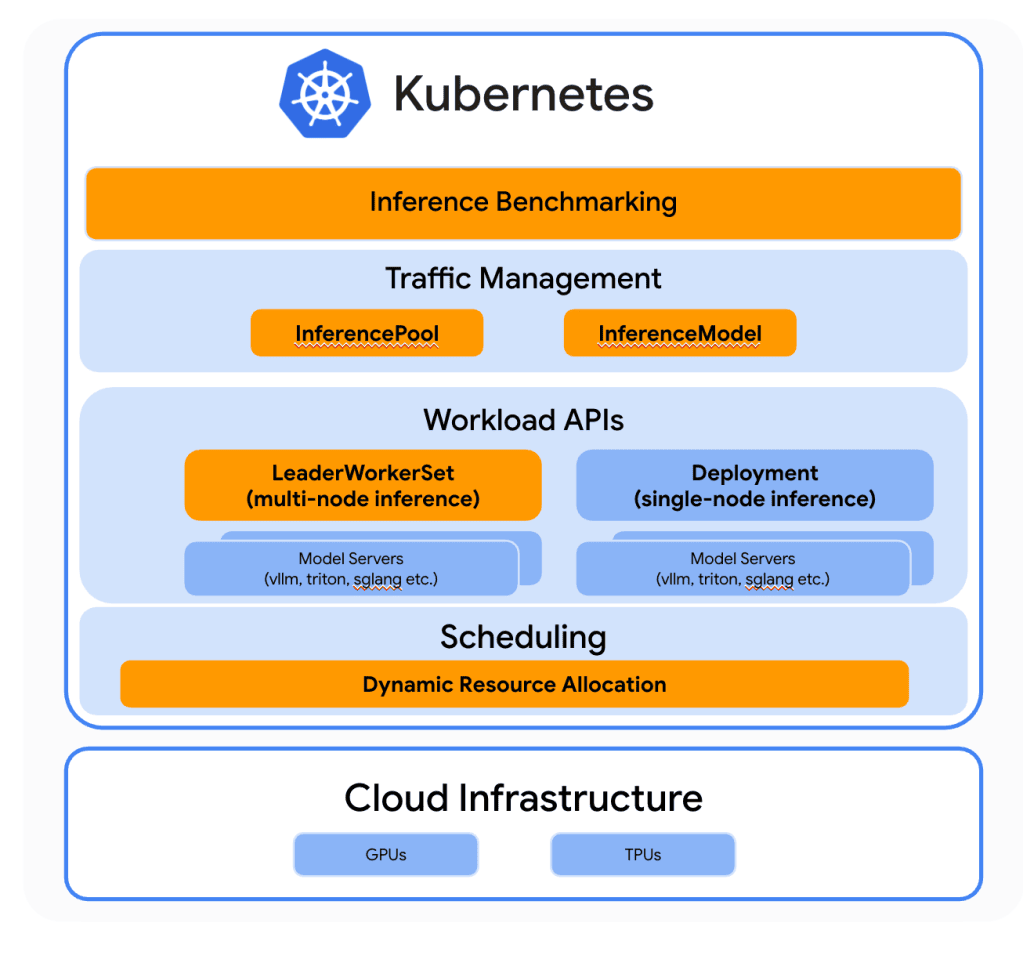
Scaling modern open-weights models requires tackling two distinct bottlenecks that standard infrastructure tools were never built to handle. You have reinforcement learning loops that leave expensive hardware sitting idle, and you have inference routing that destroys your key-value caches under heavy agent traffic. Google recently outlined these challenges in their overview of the open AI-native stack on Kubernetes (opens in new tab), highlighting projects designed to fix these exact failure modes.
If you have ever run reinforcement learning post-training on a cluster, you know the pain of utilization drop-offs. Traditional setups alternate between generation phases, where workers sample trajectories from the model, and training phases, where the model updates its weights. During generation, your training memory sits empty. During training, your rollout workers wait around. OpenRL handles this by interleaving training steps and rollout inferences on the same physical accelerators, using delta-weight synchronization to push only parameter changes rather than full model weights across the network.
Serving those models under production agent traffic introduces a completely different set of scaling hurdles. Standard round-robin load balancers treat every inference request like a stateless web query, completely ignoring the prompt context. When an autonomous coding agent makes ten sequential tool calls, scattering those requests across random pods destroys your prefix cache. You end up recomputing identical tokens on every turn, driving up latency and burning through GPU cycles.
To fix this, the newly introduced llm-d framework brings prefix-cache-aware routing to the Kubernetes control plane. It tracks where key-value caches live across your cluster and routes incoming requests to the pod that already holds the relevant context in memory. Meanwhile, KubeRay and Kueue manage elastic autoscaling for distributed Ray workloads, allowing compute-heavy data processing and model training to share GKE clusters without stepping on your production inference traffic.
How do you secure multi-tenant AI agents and distributed inference on Kubernetes?
Security gets complicated the moment your models stop generating plain text and start executing code. When an autonomous coding agent writes a Python script to analyze a CSV file or drops into a Bash shell to inspect a repository, that code has to run somewhere. In a shared Kubernetes cluster, running model-generated scripts inside standard containers is a massive risk. Container namespaces restrict file system visibility, but they still share the host kernel. A bad prompt injection or a rogue system call from an unvetted script can compromise the underlying node.
This is where gVisor fits into the security architecture. Operating as a CNCF Sandbox project, gVisor acts as a user-space kernel that intercepts system calls made by the application. Instead of allowing containerized agent processes to speak directly to the host Linux kernel, gVisor handles those calls inside its own sandbox layer using the runsc container runtime. If a model-generated script attempts an unauthorized syscall or tries to manipulate local network sockets, it hits gVisor’s virtualized boundary. I use similar user-space sandboxing on shared web hosting nodes to prevent tenant privilege escalations, and the same logic applies directly to AI agents.
At the hardware layer, multi-tenancy also requires flexible framework support so you are not locked into a single GPU vendor. TorchTPU integrates native PyTorch support into upstream inference engines like vLLM and SGLang. Historically, high-throughput engines were tightly coupled to NVIDIA CUDA extensions, making Cloud TPUs awkward to run in the same cluster management model. TorchTPU eliminates that divide. You can deploy vLLM pods against Cloud TPU v5e slices alongside standard H100 nodes, using the exact same PyTorch primitives and container definitions across your entire fleet.
What it means in practice for platform engineers
The gap between writing training code and managing infrastructure often feels unbridgeable, but the new primitives change that equation. With OpenRL, a researcher writes standard Python. They define four core functions: forward_backward, optim_step, sample, and save_state. They do not write kubectl commands or manage pod lifecycles manually. OpenRL interprets these calls and schedules them across the cluster. This means the engineering team can focus on reward function logic and data curation while the platform handles the orchestration. It is a significant shift from the era of hand-crafted YAML files for every experiment run. I have seen teams spend weeks just trying to get a distributed training job to start on a standard cluster. This abstraction removes most of that friction.
On the serving side, the operational focus shifts from simple load balancing to cache management. When you enable prefix-cache-aware routing in llm-d, you stop treating every inference request as independent. The system recognizes that a multi-turn agent conversation shares context with its previous turns. Instead of round-robin scattering requests to random pods, it routes them to the specific node that already holds the key-value cache for that conversation. For a site owner, think of it like a library system. If I am reading a book, the librarian knows I am still on page ten and keeps that copy nearby. If I move to a different branch, I have to fetch the book again, wasting time. Standard load balancing forces that unnecessary fetch every single time. Cache-aware routing keeps the book on the same table.
Governance becomes more complex but more predictable. Tools like Kueue and KubeRay allow you to set strict quotas. You can limit how many A100 GPUs a specific AI team can consume simultaneously. You can enforce that one department’s reinforcement learning job cannot starve another department’s high-priority inference traffic. This level of control was rare in earlier Kubernetes environments. Now, the hardware scheduling is deterministic.
I expect that within the next year, hardware abstraction layers will mature enough to let teams mix GPU and TPU nodes without changing their inference code. This will reduce the “vendor lock-in” anxiety that currently keeps many platform engineers hesitant to adopt non-NVIDIA accelerators. Until that happens, I advise testing these stacks on a small, isolated development cluster first.
To start, pull the sample manifests from the official Google Cloud blog post (opens in new tab). Deploy the llm-d control plane on a test cluster with two nodes. Write a simple agent loop that makes ten sequential requests. Then, monitor your cache hit rate using the observability dashboards included in the repo. If you see the hit rate stay consistent across the ten calls, you have successfully implemented the routing logic. If you see spikes in latency after the second call, check your network configuration for cross-node traffic. This single test will tell you more about your cluster’s readiness for stateful AI workloads than any benchmark.
What to expect next for open-source AI infrastructure
The donation of projects like OpenRL, llm-d, and Agent Substrate to the CNCF Sandbox marks an important shift in how cloud-native AI systems develop. In the past, tech companies would publish a research paper, drop a massive Python codebase on GitHub with minimal documentation, and leave platform operators to figure out production deployment on their own. By moving these projects into the CNCF, the development cycle aligns directly with standard Kubernetes API design, custom resource definitions, and open governance. Over the next twelve to eighteen months, expect these tools to consolidate into tighter, pre-integrated controller patterns rather than remaining loose collections of scripts.
I expect the biggest operational improvement will come from hardware abstraction layers for heterogeneous fleets. Right now, running a mixed pool of NVIDIA H100 GPUs alongside Google Cloud TPU v5e chips requires maintainers to manage distinct deployment manifests and custom engine configurations for vLLM or SGLang. With TorchTPU pushing native PyTorch execution directly into downstream engines and OpenRL using dynamic resource allocation claims, the underlying hardware type will eventually become an execution detail rather than an architectural barrier. A platform team should be able to submit an inference request with specific latency targets, leaving the Kubernetes scheduler to place the job on an available TPU slice or an idle GPU node without developer intervention.
That transition will not happen overnight. Early adopters will run into friction around unified metrics collection, divergent memory access patterns, and cold-start differences between GPU CUDA kernels and TPU XLA compilation. I do not know how smoothly these sandbox projects will handle cross-accelerator failover when hardware shortages force a migration mid-training run. Moving the control plane away from bespoke Python wrappers and into upstream Kubernetes controllers is still the right direction for long-term operational sanity.
Next steps for your infrastructure
If you manage your own boxes or run a small cloud deployment, migrating your production infrastructure to a new stack is not something you do on a whim. I have spent enough late nights recovering from bad cluster upgrades to know that you test everything in isolation first. The best way to understand how these tools behave under real conditions is to pull the sample manifests from the official repository and test them on your own development cluster before touching production nodes.
You can review the full architecture breakdown and find the configuration templates directly in the Google Cloud developers and practitioners blog post on the open AI-native stack on Kubernetes (opens in new tab).
Start by provisioning a small staging cluster with at least one node featuring a modest GPU or TPU accelerator. Apply the base OpenRL custom resource definitions and deploy the llm-d control plane using your local helm charts or kubectl manifests. Send a synthetic benchmark workload through the prefix-cache-aware router to watch how cache hit rates change compared to your default ingress controller. Do not push live user traffic through the new system until you have verified that gVisor isolation rules actually catch and contain arbitrary script execution inside your test runner pods. If you run into scheduler deadlocks or resource starvation during your initial tests, check your Kueue queue configurations and verify that your node affinity rules match your actual hardware availability. Taking these precautions now will save you from painful rollbacks when your models finally meet real-world production traffic.