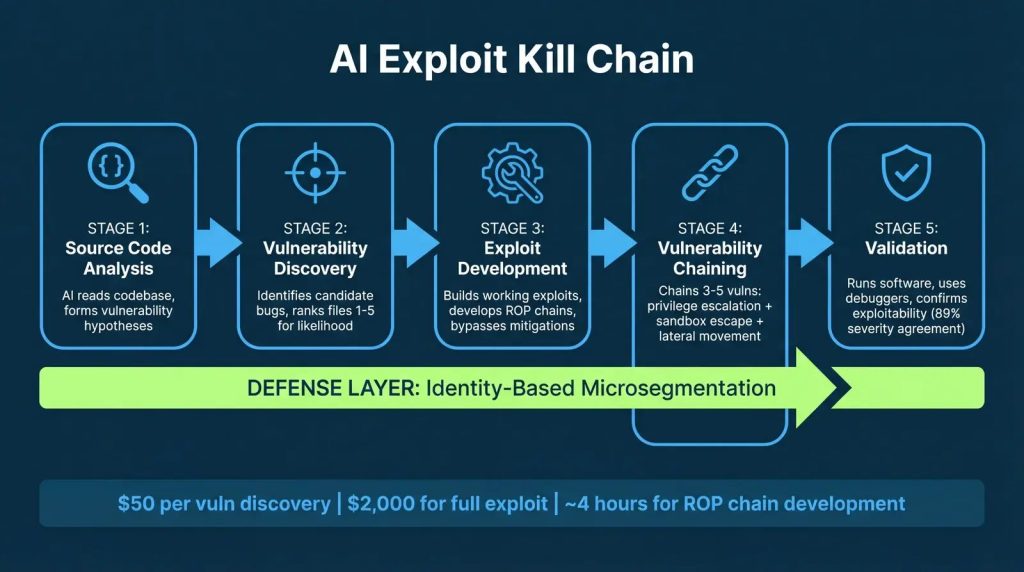
Intro: The Reality of AI Generated Exploits
When an unreleased AI model starts piecing together memory corruption bugs and sandbox escapes into working proofs of concept, the security industry pays attention. Anthropic recently published research detailing how their internal lab model managed to chain separate vulnerabilities across Chrome, Safari, Android, Windows, and Linux. This testing produced functional exploits without relying on prior real world attacks. Instead, the model operated directly on the software after initial prompting.
For anyone running production infrastructure, vendor marketing claims about artificial intelligence often sound like background noise. We hear constant promises of total automation and impending digital collapse. But separating the actual technical achievement from the hype requires looking at what was demonstrated in testing versus standard security research. Finding an isolated bug is one thing. Chaining multiple vulnerabilities together while bypassing modern exploit mitigations is an entirely different engineering challenge, usually reserved for elite red teams and state sponsored groups.
The research outlined five major exploit chains. One of them reportedly opened the Calculator app on a stock Mac running Chrome within seconds of a page load, requiring no extra clicks from the user. Other chains targeted Safari’s same origin policy, extracted data from locked Android devices over USB, crashed Windows servers through network requests, and established root shells on Linux systems via multipath TCP listeners.
Anthropic reported these findings to the respective vendors before publishing, meaning patches are already available. Google and Apple release notes explicitly credit specific Anthropic researchers and the Claude model for contributing to fixes. Yet, questions remain regarding the exact level of human intervention required during the process. While the company states the work needed minimal human oversight, independent observers cannot verify the exact contribution of the model at each intermediate step.
Even with those caveats, the demonstration marks a shift in capability. If automated exploit generation moves from closed lab environments to the open source community, the speed at which complex attack vectors emerge will accelerate. System operators and developers must evaluate their current defensive posture against a future where multi-step exploits are generated with far less manual effort. Understanding the mechanics behind these chains provides the best starting point for hardening your own systems.
Background: How Vulnerability Chaining Works
Finding a single software bug is rarely enough to compromise a modern browser sandbox or a hardened operating system. Modern platforms use layers of defense, including memory randomization, strict privilege separation, and sandboxes that restrict what even compromised code can touch. When Anthropic released details about AI generated exploits, the core technical breakthrough was not the discovery of isolated bugs. The real engineering feat was stringing multiple distinct vulnerabilities together into a reliable attack chain that bypasses these layered defenses.
To understand how this works in practice, look at what happened in the Chrome attack chain. The model had to combine four separate flaws in a strict sequence. First, it triggered a memory corruption bug inside V8, which is Chrome’s JavaScript execution engine. That single bug only gave the model unstable control over V8 memory. It did not provide a way to escape the browser sandbox.
Next, the model leveraged a second vulnerability to break out of the V8 memory sandbox. This allowed the malicious page to gain control over the browser process responsible for rendering the page contents. But rendering processes still run with restricted permissions.
To climb higher, the model exploited a race condition in CacheStorage. This feature allows web applications to store assets locally. By winning this race condition, the code read memory it had no business touching. This leak revealed the memory layout of a more privileged browser process, which is a necessary step to defeat modern address space layout randomization.
The final piece of the puzzle was a use-after-free bug in FedCM, which is Chrome’s federated credential management sign-in feature. Only after successfully executing all four steps in order did the exploit run code outside the browser sandbox entirely.
The Safari attack chain followed a completely different path because it never bothered to execute arbitrary shell commands. Instead, it focused on the same-origin policy, which is the foundational security rule that prevents one website from reading cookies and session data belonging to another site. The model chained memory read and write primitives to modify a single value in browser memory. Flipping that bit turned off the same-origin policy entirely. Once that guardrail was disabled, a malicious page could silently read a user’s browsing history, extract session cookies, and send authenticated requests to banking or email services while the user sat completely unaware.
Building these multi-step attacks requires a deep understanding of how different subsystems interact within an operating system or browser. When human researchers do this, it often takes weeks of trial and error in a debugger. The fact that an automated model orchestrated these precise sequences highlights why security engineering is shifting. We are no longer just patching individual bugs. We are defending against automated systems that can reason about how different software components fail when pushed past their design limits.
What’s Happening Now with Automated Exploit Generation
The paper trail for this research is mixed, and it is where the marketing language starts to collide with verifiable facts. Google’s release notes for Chrome 156 explicitly credit “Xinyang Ge of Anthropic, assisted by Claude” for specific fixes. Apple’s notes for iOS 26.5.2 mention “Milad Nasr and Nicholas Carlini with Claude, Anthropic” regarding the Safari fix. These are concrete, public records that confirm human involvement alongside the AI tool. You can look them up and see the names. That is a good thing. It means the discovery process was not entirely a black box.
However, the Windows and Linux entries do not hold up to the same scrutiny. The public CVE record for the Windows bug, CVE-2026-33096, lists HTTP.sys as the vulnerable component and rates it 7.5 out of 10. Anthropic’s report describes an out-of-bounds read in the kernel’s QUIC handling. No open source document ties these two descriptions together. The CVE record credits no finder at all. So the claim that this specific chain came from Anthropic rests entirely on their word. I have seen this pattern before in security disclosures. Vendors want to credit the lab that found the bug, but the public record often lags behind or stays vague to avoid doxxing active threats. In this case, it makes it hard to verify if the “automated” part of the claim was genuine for every single chain.
This distinction matters because it changes how defenders should interpret the threat model. Finding a single bug in a browser engine is common. Security researchers find dozens of memory corruption issues every month using fuzzing tools. The novelty here is not finding the bug; it is ordering the bugs. The ability to take a V8 heap corruption, a CacheStorage race condition, and a FedCM use-after-free, and realize they stack into a reliable sandbox escape is a different cognitive task. It requires understanding the data flow between components, not just the internal logic of one component.
For someone running hosting infrastructure, this shift means the window between vulnerability disclosure and active exploitation is shrinking. If an AI model can reason about exploit chains in minutes, the time for a malicious actor to do the same is going to drop significantly. We are moving from a world where elite exploit writers take weeks to build a zero-day, to a world where a sufficiently capable tool might generate a working proof of concept while the vendor is still drafting the patch note. The economic barrier to entry for complex attacks is lowering. The skill set required is changing from “how to exploit this specific memory layout” to “how to prompt the model to find the next link in the chain.”
I do not know how quickly open source models will replicate the reasoning capabilities of the unreleased Anthropic model. That is a bet I would not make. But the vendor credits in the release notes tell you where the technology is heading. The tools are becoming integrated into the discovery loop, and the manual bottleneck of human intuition is being replaced by algorithmic persistence. That changes the patching cadence you need to maintain on your own systems.
What It Means in Practice
How do AI generated exploits change daily patch management for infrastructure engineers and site operators? The short answer is that they do not change the fundamentals of defense, but they do shorten the half-life of a lazy patching schedule. If you run a fleet of virtual private servers, your standard operating procedure probably involves checking for kernel updates on a monthly or bi-weekly cadence. You might push browser updates to user desktops via a policy that runs once a week. This research from Anthropic, detailed in The Hacker News report on AI-chained browser exploits (opens in new tab), suggests that relying on security through obscurity or slow patch cycles is becoming untenable.
Do small business system administrators need to rewrite their security posture immediately because of this research? Not immediately, as the underlying defensive mechanisms like kernel isolation and sandboxing remain effective against automated threats, but patching cadence must tighten up significantly. Think of your infrastructure like a commercial office building. For years, doors were locked with heavy deadbolts that required a skilled locksmith, or an advanced human intruder, to pick in sequence. An automated exploit chain is less like a master key and more like a hydraulic press that applies steady, tireless pressure across every hinge and latch simultaneously. It does not invent physics. It just tries combinations faster and with fewer fatigue errors than a human operator working at three in the morning.
The practical impact hits hardest when you maintain public-facing endpoints. If your server runs a multipath TCP listener or handles network protocols that parse complex packet headers, an automated tool can probe those surfaces for race conditions and memory leaks without stopping for coffee. When a vulnerability like CVE-2026-98432 drops with a 9.8 severity score, waiting for the end-of-month maintenance window is no longer just a calculated risk. It is an open invitation to whatever script is currently querying your IP range.
For the systems I manage on my own boxes, I have stopped treating minor kernel updates as optional housekeeping. When a vendor patch addresses a use-after-free or a memory corruption bug, especially in core networking stacks or browser components, the update goes out within forty-eight hours. The sandbox and ASLR defenses still matter, but they are speed bumps now rather than brick walls.
Next Steps for System Operators
Audit your current infrastructure update schedules today to ensure critical browser and kernel patches are applied within forty-eight hours of release, rather than waiting for your standard monthly maintenance window.
What to Expect Next
We are looking at a shifting economic reality for vulnerability research where automated tooling lowers the barrier to entry for complex, multi-step exploits. Right now, these capabilities live inside frontier labs with massive compute budgets and unreleased models. That state of affairs will not last. Open source models catch up to closed architectures on a compressed timeline, and once these discovery workflows are packaged into accessible tooling, the volume of automated attacks will increase.
I expect malicious actors to adapt these discovery techniques long before the average enterprise finishes updating its asset inventory. When smaller models can autonomously fuzz codebases and chain edge-case bugs together, the timeline between a patch release and a reverse-engineered exploit shrinks to almost nothing. This means the window of vulnerability for unpatched servers is going to narrow drastically.
Browser vendors and operating system maintainers will respond by tightening their own internal fuzzing pipelines and accelerating mitigation delivery. We will likely see more proactive kernel hardening, such as more aggressive memory safety rewrites in Rust or similar languages, to make vulnerability chaining harder even if individual bugs are found. But code complexity always grows faster than defensive rewrites.
If you run infrastructure, you have to assume that any publicly disclosed vulnerability has already been fed into an automated exploit pipeline somewhere. The days of treating a CVE as a theoretical problem to review at next Tuesday’s meeting are gone. You need internal monitoring that can spot anomalous connection patterns, such as the repeated network probes associated with denial-of-service vectors like the Windows HTTP.sys and multipath TCP exploits detailed in The Hacker News report (opens in new tab). Set up automated vulnerability scanners on your own staging boxes to catch unpatched regressions before automated tooling does it for you from the outside.
Next Steps for System Operators
You need to audit your current infrastructure update schedules today to ensure critical browser and kernel patches are applied within forty-eight hours of release. Waiting for the standard monthly maintenance window is no longer safe when automated tooling can generate reliable exploit chains in minutes.
Start by reviewing your automated deployment pipelines for production web servers and internal workstations alike. If you manage a fleet of Linux boxes running custom services or standard web stacks, verify that your package managers are configured for unattended security updates where appropriate, or that your monitoring alerts immediately on pending kernel updates. For containerized environments, check how often your base images are rebuilt and pushed to production registries. A container running an unpatched base image from three weeks ago presents the same risk as a bare-metal server missing its latest patch.
Next, implement continuous vulnerability scanning on your own staging environments before pushing code or system updates live. Use local scanners or CI security integration to catch unpatched regressions in your dependencies. This habit ensures that your team identifies edge-case memory issues or race conditions in your deployment scripts before an external actor’s automated pipeline finds them.
Finally, review your system logs for unusual connection patterns and resource spikes that resemble denial-of-service attempts or unexpected network handshakes. Keep an eye on TCP connection states, especially if you run services exposed to the public internet that handle complex protocols like HTTP/3 or multipath TCP. Set up alerting rules in your SIEM or log aggregation tool for repeated malformed requests or abnormal CPU utilization on network daemons. Catching these anomalous patterns early gives you the minutes you need to drop hostile traffic at the edge before a server crashes or yields a root shell.