Intro
GitHub Security Lab recently shipped the Taskflow Agent, and the plain-language version is this: you point it at a repository, it reads the code, figures out where a fuzzer might find something interesting, writes the use code itself, runs the fuzzer, and then filters the noise from the crashes that actually matter. This is AI-powered fuzzing in the sense that the bottleneck that kept fuzzing from reaching most projects, the use writing step, has been handed off to an LLM that can read source code and emit compilable C or C++.
If you already maintain fuzz uses for your C or C++ projects, this is useful as a second pair of hands that can spot entry points you missed. If you have never written a use because the setup cost felt too high, this is the thing that finally makes automated vulnerability research accessible without the traditional legwork. The setup cost used to be brutal: you had to identify a parsing function, understand its exact input contract, write a use that fed it bytes in the right format, link it against libFuzzer or AFL, and then debug why the fuzzer was crashing on inputs that were never valid in the first place. For a library nobody has touched since 2014, that alone could eat a week. The Taskflow Agent removes that week.
Either way, the framing matters. The Taskflow Agent writes and runs fuzzers. It does not hand you a patched bug or a CVE. That distinction decides whether you get value from it, because the tool stops where the human begins. You still have to reproduce the crash, minimize the input, check the backtrace, and decide whether it is a real vulnerability. What the agent gives you is the use and the crash report, not the verdict.
The primary source is GitHub’s blog post on AI-powered fuzzing with the GitHub Security Lab Taskflow Agent (opens in new tab).
Background: how fuzzing got to AI-powered fuzzing
I have done this the old way enough times to remember the shape of it. You clone the repo, add -fsanitize=fuzzer,address to the build flags, then read source until you find a function that takes a pointer and a length. Then you write the use by hand:
int LLVMFuzzerTestOneInput(const uint8_t *data, size_t size) {
    parse_message(data, size);
    return 0;
}
If the parser expects a header before the payload, or a magic number at offset zero, or initializes global state on the first call, you find that out by watching the fuzzer return instantly with zero coverage. So you go back, add the magic bytes, fix the length check, build again. Then you seed a corpus, point the runner at it, and let it sit. A week later there are four hundred files in crashes/ and every one of them is the same null dereference in an error path the maintainer already knew about. That part has not changed and will not change.
The engine was never the problem. libFuzzer and AFL have been good at coverage-guided mutation for years, and mutation strategy is not where projects stall. The stall is the use. Writing a correct one means reading unfamiliar source, inferring an input format from struct definitions and parse loops, and knowing enough about the build system to link the whole thing together. Asking a maintainer to do that speculatively, for a library that gets one commit every eight months, is asking for a week they will not spend.
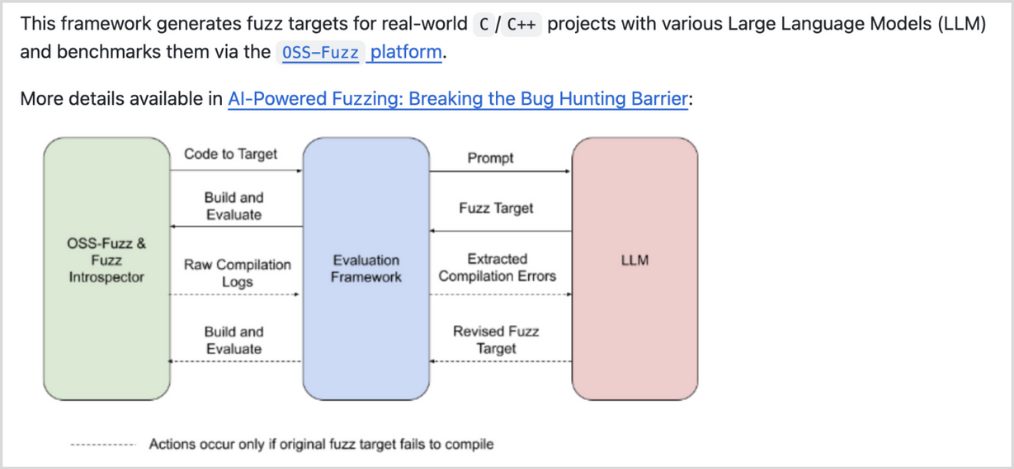
What changed is that an LLM can do that reading. It can open the source, infer roughly what the wire format looks like from the parse function, emit a use that compiles, and iterate when the first attempt fails to link. GitHub Security Lab’s post describes this as what the Taskflow Agent is built for, and having written a few uses by hand, I think the compile-and-iterate loop is where the real value sits. Guessing the format is table stakes. Being able to fix the guess without a human in the chair is the difference.
Worth being clear that this is still coverage-guided fuzzing underneath. The agent picks the target and writes the driver. libFuzzer still does the mutation, the compiler still instruments coverage, and crashes still arrive as raw input files with names like crash-6f2a1b. Nothing about the underlying technique has been replaced, which is exactly why the whole thing can work at all.
What is happening now with the GitHub Security Lab Taskflow Agent
GitHub Security Lab published a writeup on the Taskflow Agent (opens in new tab) applied to fuzzing, and the framing is narrower than the headline suggests. It is an agent framework pointed at a repository, with fuzzing as the use case. There is no new fuzzing engine in the box, no replacement for libFuzzer, and no claim that the agent understands your codebase better than you do. What it claims is that the reading and writing work in front of fuzzing can be handed off.
The workflow shape, as I read it:
- The agent walks the repository and proposes candidate fuzz targets, ranked by whatever heuristic the prompt gives it.
- It writes a use for a chosen target and attempts to compile it.
- It runs the use under a fuzzing engine and collects crashes.
- It filters the crash reports before they reach you.
Of those four, I am confident about the use writing and running, because that is what the post is about. Target ranking and crash filtering are the parts I am treating as likely rather than certain until I see the agent’s own output on a repo I know. Sanitizer builds are assumed, since fuzzing without ASan catches far less.
Where it executes matters for whether you can actually adopt it. The GitHub Security Lab tooling lives in the Open Source Security Foundation family and typically runs inside a container, either on a GitHub Actions runner or locally. That means your project has to build in a Linux container from a clean checkout with no interactive steps. If your build wants a specific compiler version installed by a shell script, or pulls a vendored dependency from a private mirror, you will spend your first day on the build recipe and not on fuzzing.
The limits are the same ones a human faces. Vendored third-party parsers confuse target selection. Projects that need real hardware, licensed SDKs, or a kernel module are out of scope for a containerized run. And a codebase with a fifteen-minute full build will make every agent iteration expensive, because the compile happens before every fuzz run.
None of that is a criticism of the release. It is the honest boundary of what an agent in a container can do, and knowing the boundary saves you a wasted afternoon.
What it means in practice: AI-powered fuzzing on your own repos
Four questions keep arriving whenever I mention this to other maintainers.
Does this replace the fuzzing setup I already have? No. If you have a use that compiles and a corpus with a few thousand seeds, the agent is a second pair of hands for finding entry points you missed, not a replacement for the engine. libFuzzer still does the mutation and still decides which inputs get kept. You still own the triage. The only thing that changed is who types the use, and honestly, that was the part nobody wanted to do.
How much CI time does it burn? More than you expect. Fuzzing is measured in CPU hours, and every agent iteration builds the project before it runs a single input. On a small CMake library with a clean -fsanitize=fuzzer,address build that is twenty seconds. On something that links half of Boost it is twenty minutes, and the agent will cheerfully do that ten or fifteen times while it works out which function to target. Put it on a nightly schedule against one target. Do not wire it to pull requests, because a PR that fixes a typo in the README does not need a quarter hour of fuzzing behind it.
Can I trust a crash the agent reports? Treat it exactly the way you treat a stack trace from someone opening their first issue. It might be a real heap overflow, it might be the same null deref you fixed in 2019, and the backtrace might point at a frame that has nothing to do with the cause. The report only counts if the crashing input comes with it. Without that input you cannot reproduce it against the same binary with the same sanitizer flags, and if you cannot reproduce it, you are looking at a rumour rather than a bug. Minimize it, confirm it, then write it up.
Does this work for JavaScript or Python projects? Assume not until the documentation says otherwise. A fuzzer wants a compiled entry point that accepts a byte buffer and does not fall over when the buffer is nonsense. The useful targets are C, C++, and compiled Rust with a parser at the front door. That regex bug in a WordPress plugin is still going to a human reviewer with a browser and too much coffee.
The through line across all four is the same. The agent removes typing. It does not remove judgement.
What to expect next
Writing the use is the easier half of this problem, and it is the half that shipped first. A use is a text file. You compile it, and you find out immediately whether the agent got the signature right, because the linker complains. That is a signal you can act on without thinking hard about it. The step everyone is visibly aiming for next is an agent that reads the crash report, decides which of the four hundred frames in the backtrace actually matters, and proposes a patch. That is a different class of problem. The output stops being an artifact and becomes a claim, and a wrong claim costs a maintainer an afternoon of chasing a heap corruption that turns out to be a bug in the use itself.
What would change how I read the next announcement is a report that shows up already carrying a minimized input and the exact command to reproduce it. Not a link to a CI log I have to dig through, not a description of the bug in prose, but a file I can pipe into a binary and watch crash on my own machine. GitHub has been good about this in the Security Lab’s public advisories, and if the Taskflow Agent release (opens in new tab) pushes that habit into the automated path, the triage burden drops for everyone downstream.
My honest uncertainty is about scale, and it is not a small one. Every example I have seen so far involves a project where a clean build finishes in seconds. On a repo where configure and compile take twenty minutes, an agent that wants to try six use variants and run each one for ten minutes is looking at a couple of hours before it has anything to report. Three attempts an hour is not a research loop, it is a coffee break with extra steps. I do not know whether the team has a plan for incremental builds, cached object files, or some way of narrowing the target list before it starts compiling. On my own boxes, the projects I most want fuzzed are exactly the ones with the worst build times, and that is where I expect this to feel least impressive for a while.
Closing: pick one target this week
The build time problem is real, but it is also a reason to start small, not a reason to wait. You do not need to fix your entire build system before you see whether this thing works. You need one repository where a clean compile finishes in under a minute, and ideally a single function that takes a buffer and returns a struct. That is the low-hanging fruit, and it is where the agent has the best chance of producing something usable.
Pick a branch, not your mainline. Point the Taskflow Agent at it and let it run. If it finds nothing, that is not a wasted afternoon, because the use it wrote is still sitting in your branch. A use you did not have to write yourself is the actual deliverable here, and it is worth more than the empty result it came with. You can wire it into your own CI later, feed it a corpus, and let libFuzzer or AFL do the slow work while you go back to your normal tickets.
Then run it again next month against the same target. The second run tells you more than the first one did, because the agent will have learned from the codebase changes you made in between, and you will have a second data point on how good its uses actually are. One target, two runs, six weeks apart. That is a research loop you can sustain without burning a weekend.
If you are wondering where to start, look at the libraries your own code depends on. They usually have a parsing function somewhere, they usually build quickly, and they usually have not been touched since 2014. That is exactly the scenario this was built for.
Now go pick one.