Intro
I have spent the last several years watching customers stare down multi-rack Outposts deployments and walk away empty-handed. The math never worked for anyone running fewer than fifty racks of their own. A regional clinic, a manufacturing plant on the outskirts of town, a branch office with a closet that doubled as a server room. They all needed AWS APIs on premise, and they all hit the same wall: the footprint was too big, the cooling requirements were unreal, and the sales cycle ran longer than most project budgets could survive.
That wall just cracked. AWS made second-generation single-rack Outposts generally available in September 2026, and it changes the conversation for anyone who has ever looked at a floor plan and known there was no way a multi-rack unit would fit. This is part of the broader wave of AWS new features September 2026 brought, and the single-rack announcement is the one I have been waiting on for a long time.
When I talk to site operators, the question is never whether they want AWS services at the edge. It is whether they can actually build the infrastructure to support it. The old answer required a raised floor, a dedicated cooling loop, and a facilities contact who understood rack units and power distribution like an electrician understands wiring diagrams. Most small sites did not have that person on staff. I have had to turn down Outposts assessments myself because the customer had eighteen racks of space and needed twenty-two. The gap between what they had and what AWS needed was just too large to bridge in a reasonable timeframe.
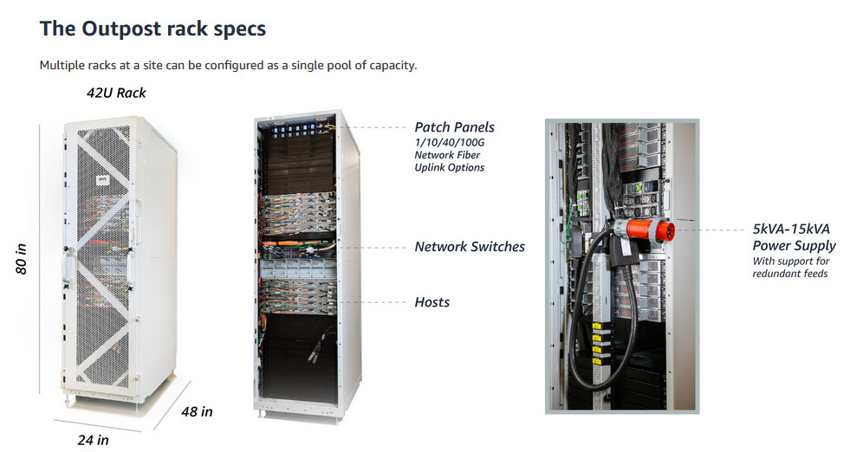
A single 42U rack sits inside a standard equipment cabinet. It plugs into existing power and cooling. It does not demand a room改造. For the first time, a healthcare clinic in a suburban strip mall or a distribution center with a converted storage closet can run EC2, EBS, and the full AWS control plane without turning their facility team into a datacenter operations team. That is not a incremental improvement. It is a structural shift in who gets to run Outposts.
I am not saying this removes every barrier. I still do not know how hardware replacements work at a single-rack site when you lack the redundancy of a larger deployment, and pricing has not landed yet. But the physical constraint that kept this product locked behind enterprise accounts is gone. The question now is whether your workloads fit inside the limits, and whether the economics make sense compared to spinning up the same thing in a regional AWS Region. That is what I want to dig into.
Background
AWS Outposts is not a new idea. The concept has existed since 2018, and it was built for a very specific problem: teams that need to run AWS services physically inside their own walls. Some workloads cannot leave a premise because of data residency rules, latency requirements, or regulatory constraints. Outposts gives you the same APIs, the same control plane, the same IAM, the same CloudTrail and Config tooling, but sitting on hardware that lives in your building rather than in an AWS Region.
The original implementation was designed for medium and large enterprises. Multi-rack Outposts deployments require dedicated floor space, raised flooring in most cases, proper cooling capacity, and a facilities team that understands power distribution units and rack airflow. That kept them anchored to headquarters datacenters and large regional offices. A small branch site, a manufacturing plant, or a healthcare clinic simply did not have the infrastructure to host one, and they could not justify building it just to run EC2 instances.
AWS has been quietly iterating on the form factor while keeping the control plane consistent across deployments. That pattern shows up everywhere in how they approach hybrid cloud. The software stack does not change between a multi-rack installation and a single-rack unit. You still get the same APIs, the same console, the same automation, the same governance, and the same security controls. The difference is purely physical. A single 42U rack is compact enough to sit in a standard equipment cabinet and plug into existing building power and cooling. It does not demand a room retrofit.
I have seen organizations turn down Outposts assessments because the customer had eighteen racks of available space and needed twenty-two. The gap between what they had and what AWS required was too large to bridge in a reasonable timeframe. That is no longer the conversation. The single-rack option removes the facility barrier that kept this product locked behind enterprise accounts with dedicated datacenter space.
The source material for this launch comes from the AWS Weekly Roundup posted on September 14, 2026 (opens in new tab), which confirms the general availability of the second-generation single-rack Outposts and its specifications. I will get into what those numbers mean for actual deployments in the sections that follow.
What’s happening now: AWS New Features September 2026
AWS dropped a cluster of releases this week, but the single-rack Outposts launch is the one that changes the physical infrastructure equation for anyone running hybrid workloads outside a Region. The second-generation single-rack Outposts is now generally available, delivering a self-contained 42U unit with compute, storage, and networking packed into a footprint that fits where a multi-rack installation never could. That single rack provides up to 2,688 vCPU and 100 TB of Amazon EBS storage. It runs the same x86 instance families you would find in a larger deployment: M7i, M8i, C7i, C8i, R7i, R8i, plus Outposts accelerated networking instances.
This is not the only thing AWS shipped during September 2026. The same week brought OpenAI GPT-6 Astra to Amazon Bedrock, a desktop app for Amazon Quick hitting general availability on macOS and Windows, a Lambda Managed Instances timeout bump to 90 minutes, and cross-account EBS volume cloning. These are not a single product update. They are a cluster of releases that together signal where AWS is pushing hybrid infrastructure and developer tooling right now. The Outposts move is about expanding the physical reach. The Bedrock, Lambda, and EBS updates are about making the software experience inside that reach more capable.
For operators who already manage multi-rack Outposts, the new unit does not introduce a different API surface or a separate management plane. You use the same console, the same IAM policies, the same CloudTrail and Config rules. A team that provisions EC2 instances and EBS volumes on a multi-rack site can run through the same steps on a single-rack site without relearning anything. The governance model does not fracture between the two form factors.
I do not know yet how pricing shapes up compared to the multi-rack option on a per-vCPU basis. The hardware density per rack is higher, which could mean better unit economics, but the fixed cost of deploying a complete Outposts unit at a remote site includes cabling, switches, and AWS support contracts that do not scale down linearly. I am watching to see whether AWS introduces optional add-ons for networking or storage expansion on this form factor, or whether the 100 TB EBS cap stays as a hard boundary for most deployments.
What it means in practice
The single-rack Outposts removes a barrier I have watched operators hit repeatedly. A regional office in Ohio, a manufacturing floor in Texas, a healthcare clinic in Florida. They all had data that needed to stay on premise, either because of state regulations or because latency from a Region would break the application. None of them had a raised floor, a dedicated cooling loop, or facilities staff to spare. The multi-rack Outposts was not an option.
Now that same unit fits in a standard 42U rack. It delivers up to 2,688 vCPU and 100 TB of Amazon EBS storage inside one enclosure. You can run M7i, M8i, C7i, C8i, R7i, R8i instances, plus the Outposts accelerated networking variants. The control plane is identical to what you already use on multi-rack and in AWS Regions. Same APIs. Same console. Same automation, governance, and security controls.
Think about a mid-sized dental practice that stores patient imaging locally to satisfy HIPAA requirements. Last year, they were stuck running their own on-prem servers with no easy path to backup, patching, or auto-scaling. This year, they can install a single Outposts rack in a small equipment room and run their PACS workloads directly on EC2 with EBS volumes, while still using AWS Backup, CloudWatch, and IAM for access control. The physical footprint is roughly the size of a walk-in refrigerator. The facilities requirement is an outlet and a grounded rack, not a converted closet with a raised floor.
Healthcare clinics with strict data residency rules, regional offices that need low-latency access to centralized databases, smaller manufacturing sites running batch processing that cannot leave the building. These are the environments where the single-rack unit becomes viable. Teams do not need to rebuild IAM policies or reconfigure CloudTrail for a different deployment type. The workflows carry over directly.
I do have a practical concern about that 100 TB EBS cap. For a site running a single application database with moderate growth, it is plenty. For a site planning to run multiple databases, log aggregation, or a local data lake, it will constrain you faster than you might expect. I would map your current and projected storage needs before committing to the single-rack unit. If you need more, you are either adding another unit or routing work back to a Region.
The real tradeoff is not the API surface or the management experience. It is physical capacity versus convenience. You trade some headroom for a deployment that fits where a multi-rack never could. For teams that previously ruled Outposts out entirely, that is a meaningful difference.
What to expect next
I expect pricing and configuration pages to surface in the coming weeks. AWS usually keeps these slightly hidden until demand stabilizes, but the general availability date means sales and account teams should have enough information to start conversations. I am watching to see whether AWS introduces optional add-ons for networking or storage expansion on this form factor. The 100 TB EBS ceiling feels like a hard boundary right now, and I suspect teams running log aggregation or local data lakes will push for something beyond that. If AWS does not address it within six months, I would expect third-party workarounds to fill the gap.
Hybrid teams that already operate multi-rack Outposts will likely start migrating smaller workloads into single-rack units as a way to consolidate edge presence without adding floor space. A regional office that currently maintains three undersized server racks with virtualization sprawl could fit everything into one Outposts unit and decommission the legacy hardware. The management experience stays the same, so the migration path is mostly physical, not architectural.
Monitoring and operations tooling will probably see updates tailored to single-rack constraints. Capacity planning for EBS storage caps is already going to require more deliberate discipline than multi-rack deployments. I tend to think AWS will add more granular utilization dashboards for the single-rack form factor because operators are going to hit those limits faster than they expect.
I do not know how AWS handles hardware replacements or rack-level failures at a single site without the redundancy of a larger deployment. That is a gap worth watching. If an Outposts node fails inside a single-rack unit, there is no second rack sitting in the same room to absorb traffic. The failover path either goes to the AWS Region or to a secondary single-rack Outposts at another location, and neither option is painless. I have seen similar failure modes play out with other compact edge appliances, and recovery time is almost always longer than the SLA documents suggest. Until AWS publishes more detail on replacement timelines and site-level redundancy options for this form factor, I would treat a single-rack Outposts as a best-effort deployment and keep your disaster recovery plan honest about what it can and cannot cover.
If you are seriously considering this for a real site, map your current instance types and EBS usage against the 2,688 vCPU and 100 TB limits before you talk to your AWS account team. Run through a failure scenario on paper: if that single rack goes down tonight, what stays offline and how long until you recover from the Region? The answer to that question will tell you whether the single-rack unit is viable for your site or just another shiny box you cannot afford to lose.
Closing: What to do next
If your site needs AWS services on premise but you previously ruled out Outposts because of space or facilities constraints, the single-rack option actually changes the math. I have talked to enough small business operators who wrote off hybrid cloud entirely after seeing the facility requirements for a multi-rack deployment. This removes that barrier, but it does not remove the need for careful planning.
Request a single-rack Outposts assessment through your AWS account team and map your current instance types and EBS usage against the 2,688 vCPU and 100 TB limits before that conversation. The sizing calculator on the Outposts page will help you project whether your workload fits inside those boundaries. List every service that must stay local, assign approximate vCPU and storage numbers to each, and see where the gaps are. If you are running EC2 instances today and pulling data back to a Region for compliance checks, the single-rack unit may cover that path without requiring a full facility build-out.
Download the AWS Outposts sizing calculator and work through your own numbers rather than relying on generic benchmarks. I have found that site owners consistently underestimate EBS growth because they size for current usage instead of projecting twelve months out. The 100 TB limit sounds generous until you factor in database volumes, snapshot retention, and backup copies. Add up what your workloads actually consume and compare it against the published ceiling.
Decide whether the single-rack unit covers your requirements without overlapping into what a regional AWS Region could do cheaper. If your latency-sensitive or residency-bound workloads fit comfortably within the vCPU and storage caps, the On-Premises option becomes viable for locations that previously had no realistic path to Outposts. If your inventory pushes toward those limits, you may still need to evaluate whether a multi-rack deployment or a hybrid Region-based architecture makes more sense for your site.
The practical next step is straightforward. Talk to your AWS account team about the single-rack offering, run your workloads through the sizing tool, and document what happens if that rack fails overnight. If you can live with the recovery model and the capacity fits, this is a legitimate path forward for on-prem infrastructure without the facility overhead that kept Outposts out of reach before September 2026.