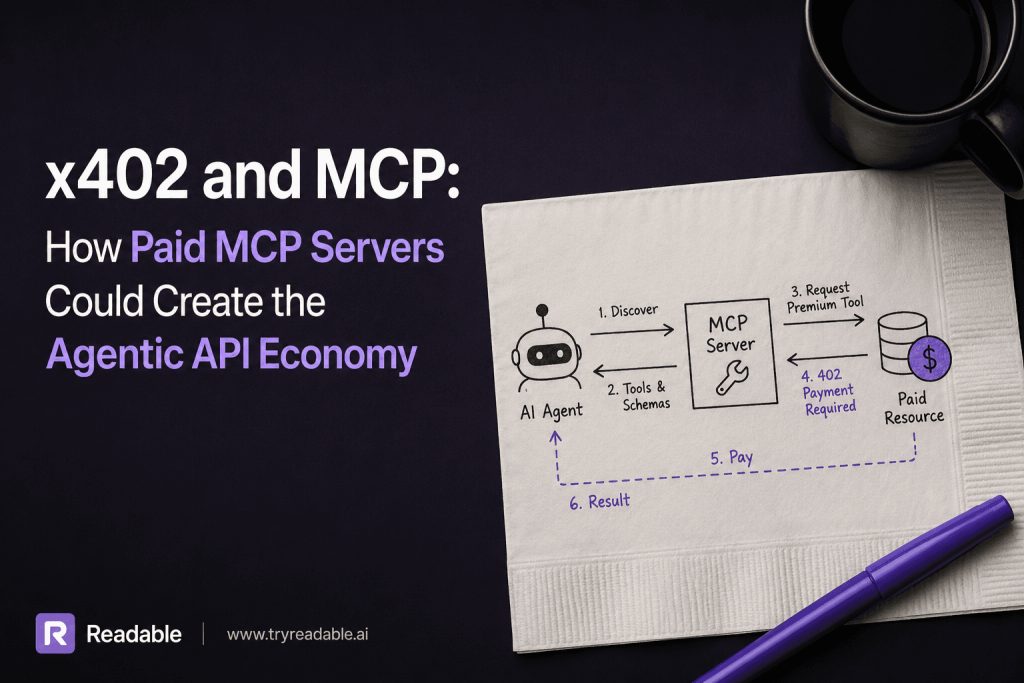
The tool call that can send back a bill
An MCP tool call used to end one of two ways. You got a result, or you got an error. There is now a third ending, and it is the interesting one. The server replies with 402 Payment Required, attaches a price and a payment destination, and does no work until somebody pays. That mechanism is what sits underneath Cloudflare x402 MCP tools, and it turns a function call into a transaction.
The question I keep getting asked is narrower than the protocol itself. A developer wires an agent up to a handful of MCP servers, the agent decides on its own to call a paid tool eleven times in a loop, and by evening there is a number attached to that decision. Which wallet paid it? Who set the ceiling on how high the number could go? Was there a ceiling, or did someone just hand over credentials and hope?
It is the company credit card problem, with the timescale compressed. You give a contractor a card because you trust them to buy materials, and you set a limit because you have never met a contractor who stops at exactly the estimate. The difference is speed. A contractor spends over a week and a human notices on Thursday. An agent can work through an allowance in the time it takes a page to fail to load, and the first person to find out is whoever reads the settlement record.
I run a small VPS hosting business, so per-request billing is not abstract to me. I pay for bandwidth, I pay per API call on a couple of services, and I have watched a runaway cron job generate overage before anyone got an alert. That taught me more about hard caps than any article did. What I have not done is operate an agent fleet at serious volume, and I would rather say that plainly than pretend otherwise. Where this post talks about production behaviour at scale, I am reading protocol documentation and Cloudflare’s announcement rather than describing my own dashboards. The billing instincts carry over. The traffic numbers do not.
What makes this worth a careful look rather than a shrug is that the payer, the payee, and the party enforcing the limit are three different entities in most setups. That separation is where site owners get surprised, and it is where I would start building.
Background: how MCP tools ended up with a price tag
The original MCP design had no billing layer, and that was deliberate. A server publishes a list of tools, a client calls them, and the call returns a result. The server owner absorbs the CPU, the bandwidth, and whatever upstream API the tool reaches into. The client pays nothing beyond its own inference cost. That held up while most servers were run by people testing an idea or by teams using the tool internally, because the traffic and the cost lived in the same pocket.
It stops holding the moment strangers call your tools in a loop. I have run enough boxes to know the expensive part of a tool call is usually not the tool logic. It is the outbound request, or the bandwidth, or the queue time while something else waits on a lock. When one agent decides to fire a hundred calls a minute at your server, you are no longer providing a service. You are subsidizing somebody else’s automation, and there is no invoice going the other direction. Fine as a hobby project. Not fine as a line item, as anyone who has opened an overage bill will tell you.
HTTP 402 has carried the name “Payment Required” since the 1990s and almost nobody used it. It was reserved for exactly this scenario and then left alone for three decades, largely because there was no standard answer to what payment and how much. Every implementation that tried invented its own header, its own token, its own settlement flow. Charging per HTTP request was never technically impossible. It was never standardized, which meant nobody wrote clients for it.
x402 is an attempt at the standardization half rather than the transport half. It rides the existing 402 status code, so there is no new protocol to negotiate and no separate API key exchange to provision. The server replies with a payment requirement, the client attaches proof, the request is retried. That is why the Cloudflare angle lands where it does: paid access can drop into a tool call that already speaks HTTP, without asking every client author to adopt a billing SDK before they can call anything.
What’s happening now: x402 payment handling on Cloudflare’s MCP server
Cloudflare adding x402 support to its agent and MCP tooling puts paid MCP tools behind infrastructure that a large share of the web already routes through. That is the part worth sitting with. This is not a small vendor shipping a billing sidecar you can sidestep by talking to the origin directly. When your agent reaches the tool through Cloudflare’s MCP server, Cloudflare is the party reading the 402, deciding what the payment requirement looks like, and letting the retried request through. The concentration is not new, but what sits inside it is. The CDN now sees not just your traffic but your willingness to pay per call.
The flow itself is short. The agent sends the tool call. The server replies 402 with the price and the payment details: which chain, which asset, which address, how much. The client’s wallet signs a payment payload. The same request goes out again with that proof attached. If the proof verifies, the tool runs and the agent gets its result. No API key to provision, no card on file, no monthly invoice to reconcile. I have not run this on my own boxes yet, so I am working from the protocol docs and the announcement reported by The New Stack (opens in new tab) rather than from production logs. That distinction matters, and I will flag it wherever I am guessing.
Settlement is where the economics get awkward. These are stablecoin payments on a low-fee chain, with per-call amounts small enough to be rounding errors. Which means the fee floor costs more than the tool does. Gas and bridge overhead on a tenth-of-a-cent call is the equivalent of wiring a rupee to save a rupee. Nobody has a clean answer for that yet, and it is the single biggest reason I do not expect ordinary cheap tools to start charging.
Do agents need their own funded wallet for x402 MCP tools, or does the platform hold the balance on their behalf? Both shapes are technically available and the source material does not settle which one Cloudflare lands on by default. A wallet the agent signs with means your exposure is whatever balance you left in it. A platform-held balance means someone else escrows your money, which is easier to operate and harder to move if you switch providers. This is the part of the announcement I would most like to see documented properly, because it determines whether your budget cap is a key you control or a setting in someone else’s dashboard.
What it means in practice: AI agent spending limits on paid MCP tools
The retry loop is what worries me. If you have ever run a shared hosting box, you have seen the version of this where a plugin gets stuck calling some external API, and by the time anyone notices the account has burned a month of bandwidth in an afternoon. The host absorbs it. You get an email, maybe a suspension notice, and the invoice at the end of the month looks roughly the same as always. Put the identical loop on per-call pricing and the invoice becomes the incident.
Every retry is a payment. A model that calls a tool, gets a response it cannot parse, and tries four more times has paid five times for one intent. That is not abuse, it is just a bad afternoon, and flat-rate APIs treat it as noise because their cost model does not care. A 402 sitting in the response path means somebody’s balance cares a great deal.
The controls exist, but they are scattered across different parties with different incentives. The wallet balance is a hard cap set by whoever funded the wallet. The per-request maximum lives inside the payment requirements the server returns, so the tool owner decides the ceiling on any single call. Any spending cap on the funding side belongs to the platform or the card issuer. That is three ceilings and three dashboards, and none of them talk to each other. Your agent’s effective limit is the lowest of the three, which is fine right up until you need to know which one fired and why.
A cap is also not a budget. It stops the bleeding when the wallet empties, but it will not tell you which of the forty hourly tool calls was the expensive one. A session that hits a cheap search tool ninety times and an expensive rendering tool twice produces a cap that says “you spent the money” and nothing more useful than that. On my own setup I would log tool name, request count, and cumulative spend per session before enabling a single paid tool, because per-call pricing without per-call attribution turns into an argument with yourself at month end, and you lose it.
What to expect next
My expectation is that Cloudflare does not stop at supporting x402 in its MCP tooling. Once a CDN is already terminating the TLS connection, seeing the 402, and passing the signed payment payload through, the step to holding balances, issuing per-agent keys, and settling on behalf of customers is a short one commercially. That would make Cloudflare the payment intermediary for a meaningful slice of MCP traffic, and it puts the same company that already sits in front of a large fraction of the web’s HTTP requests in front of the money as well. If you were uneasy about one vendor in the request path before, this does not improve the situation. I would still take it over each tool author inventing their own billing portal, because a single intermediary you can audit is easier to reason about than thirty separate ones you cannot.
Spend policy probably moves up the stack with it. Right now the ceiling lives in the wallet, which is the wrong place for it, since a wallet holds one balance for everything and has no opinion about which agent or which team spent it. Team budgets, per-agent keys, and a hard stop that fires before the retry loop reaches call fifty belong at the platform layer. I do not know how quickly that arrives, and I would not build a compliance story on it yet.
On tool pricing, my guess is that most MCP tools stay free. Charging for a tool that wraps a public API and a few seconds of CPU invites someone to host the same thing next door. The ones that charge will be the genuinely expensive ones, rendering, large model inference, scrapers that pay their own upstream costs, and once a price column shows up in discovery, those authors will be compared against each other for the first time.
The part I have no answer for is the accountant. KYC on an agent wallet, invoicing for a hundred micro-payments in stablecoins, and a bookkeeper who can reconcile either one. Someone will have to solve that before paid MCP tools reach the businesses that would pay for them.
Start with a capped wallet and a log line
If you take one thing from this, take the wallet separation. Create a dedicated wallet or funded key that exists only for agent traffic, keep a balance in it that you would not miss if it drained overnight, and never point an agent at the credentials you use for anything else. On my own boxes, the API key an automated process uses is never the same key I use at a terminal. That habit transfers directly here. A dedicated wallet is a hard cap by construction, because when the balance hits zero the 402s stop being payable and the agent stops spending. It is crude, and it works while you figure out the rest.
Then add one log line per tool call, before you enable anything paid. Not a dashboard, not an APM integration. One line, appended to a file, with the tool name, a session identifier, the amount charged, and the running total for that session. Something like {"ts":"...","tool":"render_pdf","session":"abc123","amount":"0.0004","session_total":"0.0031"} written out with jq -c on each call. The point is that per-call pricing without per-call attribution is unusable at month end, and the first surprise invoice should arrive with an explanation already sitting in a log file. If you cannot say which tool burned the money, the cap did its job and you still learned nothing.
For the actual test, pick one low-stakes paid MCP tool. Something that wraps an expensive upstream you would otherwise avoid calling, a renderer or a transcription endpoint works well. Set the smallest per-request maximum the server will accept in its payment requirements. Run a single agent session through it for a day and look at two numbers: total spend and spend per tool. I would expect the per-call cost to be trivial and the call count to be the surprise, since agents retry more than people do. Cloudflare’s x402 support, as described in the announcement (opens in new tab), puts the pricing negotiation in the HTTP exchange itself, so those numbers are visible in your logs rather than buried in a monthly statement.
If you run MCP tools for other people, decide now whether you charge, and put the price where a client can read it in the tool description. Retrofitting a price onto a tool that people already call for free is a much harder conversation than launching it with one.