Intro
On October 26, 2026, OpenAI released GPT-6.1 Terra, a model specifically engineered for high-volume visual reasoning and computer-use tasks. If you have been running agents that parse PDFs, fill out web forms, or interpret screen captures, you have likely noticed the bill. GPT-6.1 Terra is the answer to that bleeding wallet. It sits in the new GPT-6.1 series as the cost-optimized variant, designed to handle repetitive, data-heavy workloads without the premium price tag that usually accompanies frontier models.
The core proposition is simple: pay half of what you pay for GPT-6.1 Sol, but keep most of the performance you care about. On vision benchmarks, Terra lands within a point or two of the pricier models while shaving the input and output costs by 50%. This is not a marketing fluff point. It is a direct response to the reality that enterprise agents are not just running one-off reasoning tasks; they are running thousands of similar visual tasks every hour. The marginal cost of the 4,000th invoice processing job matters more than the peak accuracy on a single complex math problem.
Who is this actually for? It is for developers and teams who are currently automating screens, forms, and documents at a volume that makes GPT-6 Astra’s pricing look painful. If your pipeline ingests thousands of screenshots or product photos daily, the math changes when you can run the same job for a fraction of the cost. I have seen operations teams hesitate to run continuous vision loops because the API bill threatened to outpace the value of the data they were extracting. GPT-6.1 Terra lowers that threshold. It makes it viable to keep the lights on for always-on visual agents.
The model is not a silver bullet for every use case. It is a fast model, optimized for speed and efficiency in repetitive tasks rather than deep, multi-step logical reasoning. You will not find it matching GPT-6 Astra on the hardest coding benchmarks, and that is acceptable. For the job of matching a warehouse label to a catalog entry, or extracting fields from a scanned receipt, you do not need the most expensive brain in the room. You need a reliable, cheap pair of eyes.
For those keeping a close eye on agent infrastructure, the release of GPT-6.1 Terra marks a shift in how we price and deploy autonomous visual systems. It is no longer just about capability; it is about unit economics. If you are building an agent that looks at a screen and types into a form, the cost per interaction now determines whether you can scale to millions of users or remain stuck in the pilot phase. The numbers here are clean enough to run your own simulations, and that is where the real value lies.
OpenAI Launches GPT-6.1 Terra, Halving GPT-6.1 Sol’s API Price for Agent Work (opens in new tab)
Background
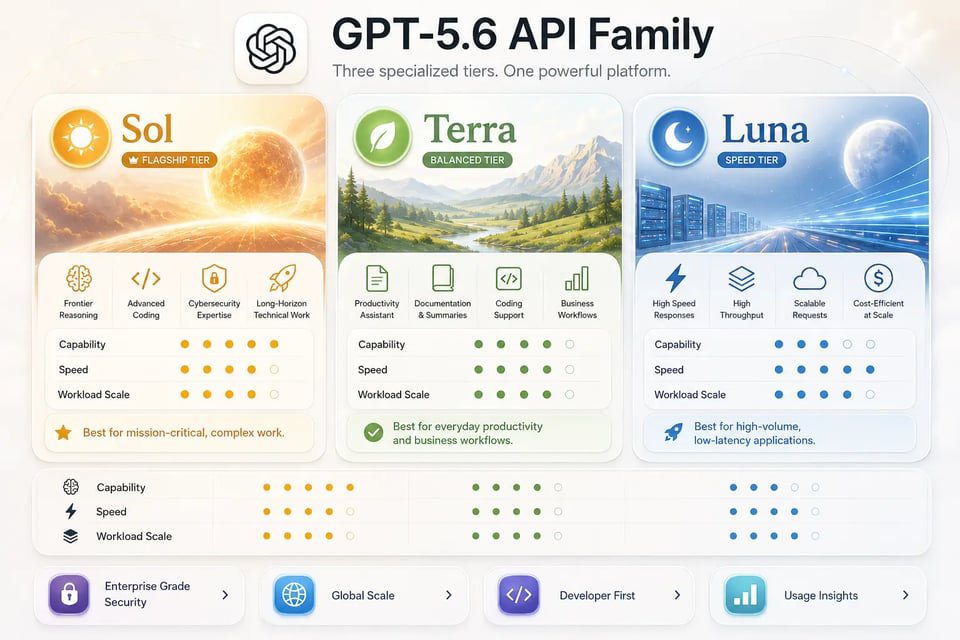
GPT-6.1 Terra sits in a specific slot within OpenAI’s current model hierarchy, replacing GPT-5.6 Terra and serving as the bridge between the high-end GPT-6.1 Sol and the flagship GPT-6 Astra. To understand why this position matters, you have to look at the technical constraints of modern agent workflows. The model is built on a 1.05 million token context window, a number that aligns with the rest of the GPT-6.1 family. This consistency is not accidental; it allows developers to maintain the same context management strategies across their stack. If you are currently building agents that ingest long logs or continuous video frames, you do not need to rewrite your truncation logic just to switch models. The maximum output is capped at 128,000 tokens, which is plenty for most tool-casing responses and document extractions, though it will clip if you are generating entire codebases in a single shot.
The most significant architectural shift here is the move to the Responses API for tool calling. Older models relied on heavier prompt engineering to get JSON outputs that parsers could handle reliably. GPT-6.1 Terra is designed from the ground up to interface with OpenAI’s newer API structure, supporting tools like computer use, hosted shells, and MCP servers natively. This reduces the “glue code” on your end. When I migrated a few of my own automation scripts to the new API structure, the reduction in parser errors was immediate. The model knows what tools are available and how to invoke them without needing a separate system prompt layer to explain the mechanics.
We also need to be clear about what “fast” means in this context. In the marketing materials, “fast” usually refers to inference speed and cost efficiency, not necessarily the raw power of deep reasoning. GPT-6.1 Terra is optimized for throughput. It is the model you deploy when you need to process ten thousand images an hour without the compute cluster burning through your monthly budget. It is not the model you call when the agent is stuck in a logic loop on a particularly nasty multi-step coding problem. For that, OpenAI explicitly points users toward GPT-6.1 Sol or GPT-6 Astra. The distinction is operational: Terra is for volume, Sol and Astra are for complexity. Confusing the two will lead to either unnecessary costs or underperformance, depending on which side of the spectrum you are on.
The lineage from GPT-5.6 Terra to GPT-6.1 Terra is not just a version number bump. It represents a maturation of the “economical” tier. GPT-5.6 Terra was often the underdog, used only when the flagship models were too expensive for the task at hand. GPT-6.1 Terra arrives with a performance profile that is surprisingly close to the top-tier models on vision benchmarks, which changes its role from “budget option” to “primary workhorse” for a huge slice of enterprise applications. This shift is critical for anyone modeling their API spend for the coming year. The gap in capability has narrowed just enough to make the cheaper model a viable default for non-critical, high-volume tasks, freeing up the expensive flagship models for the work that truly requires deep reasoning.
What’s happening now: Is GPT-6.1 Terra actually cheaper for agent tasks?
The pricing structure is where the argument for GPT-6.1 Terra becomes undeniable. Standard API rates are $1 per million input tokens and $5 per million output tokens. To put that in perspective, GPT-6.1 Sol costs double that at $2/$10, while GPT-6 Astra sits at $10/$50. If you are running a continuous loop of agents that scrape forms or transcribe documents, the difference between paying $1 and $10 per million input tokens is not a line item you can ignore after six months. I have seen infrastructure bills where a single misconfigured retry loop with a high-cost model drained a monthly budget intended for server maintenance. Terra’s price point makes that kind of runaway error significantly less catastrophic.
The per-task economics on Agents’ Last Exam v1 illustrate the scale of this gap. At medium effort, GPT-6.1 Terra completes a task for $0.29. GPT-5.6 Terra, the model it replaces, cost $0.84 for the same performance level, but actually underperformed Terra at that effort level. GPT-6 Astra matches Terra’s 57.6% success rate at medium effort, yet costs $4.82 per task. That is a sixteen-fold difference. For a team processing ten thousand such interactions a month, switching from Astra to Terra drops the monthly agent spend from nearly $48,000 to under $3,000. I do not know how often your workflow will require the absolute maximum reasoning depth of Astra, but the baseline performance gap between Terra’s medium setting and Astra’s medium setting is zero on this specific benchmark. You get the same result for a fraction of the cost.
There is another lever in the pricing structure that high-volume users will notice immediately: cached input tokens. OpenAI charges $0.05 per million cached input tokens. In agent architectures, context is often reused across multiple steps. The system prompt, the tool definitions, and the conversation history stay the same as the agent iterates. By keeping that context warm in the cache, the marginal cost of each subsequent step drops to pennies. This is particularly relevant for multi-step reasoning chains where the agent needs to refer back to previous observations. If you are building an agent that reads a fifty-page document and answers questions across ten turns, caching the initial document tokens changes the math entirely. It makes the input side of the equation almost negligible compared to the output cost.
The bottom line is that GPT-6.1 Terra is not just a discount model; it is a fundamentally different cost tier for automation. You are not simply paying less for a slightly worse version of the flagship model. You are paying a tenth of the price for a model that, on vision and computer-use tasks, performs identically to the top tier at medium reasoning levels. The cost delta is large enough to change how you architect your systems. You can afford to run more agents in parallel. You can afford to add retry logic without fearing a bill shock. The economic case is no longer “cheap enough to test,” it is “cheap enough to scale.” This is a shift from pilot projects to production deployments. If your current architecture is limited by API costs, Terra removes that constraint. The model is available in the API as gpt-6.1-terra, and the pricing is transparent. The math is simple: do the work, pay the bill, and keep the bill low.
What it means in practice
The benchmarks tell a clear story, but they also reveal a sharp dividing line in what Terra is and is not good for. If your agent workload is primarily visual reasoning or operating a desktop environment, Terra is a strong option. It scores 85.5% on MMMU-Pro (Vision) at maximum effort, which is only 1.2 points behind GPT-6 Astra. The gap is so small that for most real-world tasks, like interpreting architectural drawings or matching product photos to catalog entries, you likely will not notice a difference. OpenAI’s own recommendation aligns with this: they suggest reserving GPT-6.1 Sol or GPT-6 Astra for the most complex coding tasks, while using Terra for visual reasoning and computer use. This is a strategic signal. OpenAI is steering developers toward the right tool for the specific job, acknowledging that Terra, despite its speed and cost efficiency, is not the best model for deep code generation.
The coding performance is where Terra’s limitations become stark. On Terminal-Bench 4.0, Terra solves only 50.3% of tasks at maximum effort. Compare that to GPT-6.1 Sol at 55.9%, GPT-6 Astra at 58.2%, and Claude Sonnet 5.5 at 70.6%. That is a significant gap. If your agent needs to write complex scripts, debug intricate codebases, or navigate terminal environments with precision, Terra will struggle. Claude Sonnet 5.5, which lists at a comparable $2/$10 price point to GPT-6.1 Sol, outperforms Terra on this specific benchmark by a wide margin. This suggests that for pure coding agent tasks, the cost savings of Terra might not be worth the performance drop. You might find yourself paying the same price as a mid-tier GPT model but getting less coding capability than a Claude model.
Operationally, the availability of GPT-6.1 Terra in ChatGPT Work and Codex for Plus, Pro, and Enterprise users lowers the barrier to entry. You do not need to build a custom API integration to start testing Terra’s capabilities. You can spin up agents within the existing Codex environment and immediately see how Terra handles your specific terminal or visual tasks. This is useful for stress testing. Run your most demanding coding workflow through Terra in Codex. If it fails where Sol or Astra succeeded, you have your answer: Terra is not the right model for that part of your pipeline. Use Terra for the visual and desktop interaction layers, and route coding tasks to a stronger model. The shift is practical. You are no longer choosing one model for everything. You are choosing a model for the layer of the stack that needs it, and Terra is designed to be the high-volume, low-cost workhorse for the visual and computer-use layers.
One concrete analogy helps frame this. Think of Terra as a reliable, mid-level associate in a large firm. They handle the routine document review, data entry, and visual inspection tasks with speed and consistency. They are not the senior partner who untangles complex legal precedents or writes novel code. You would not send a Terra to a client meeting where complex coding architecture is being debated. But for the thousands of internal tasks that require reading a screen, clicking a button, or verifying a form field, Terra is the right hire. The cost structure reflects this. You pay for volume, not for genius. The trade-off is clear: you gain massive throughput and lower cost, but you accept a cap on the complexity of the coding tasks you can offload to this specific model.
What to expect next
OpenAI has a specific strategic problem that GPT-6.1 Terra is designed to solve. Their flagship models, like GPT-6 Astra, are expensive enough that many mid-sized companies hit a ceiling on agent usage. They can run a handful of complex tasks but cannot afford to scale them to thousands of daily interactions. Terra, by sitting at $1/$5, creates a volume layer. It allows OpenAI to sell massive amounts of inference to enterprises that want to automate entire departments rather than individual workflows. I expect this model to become the default recommendation in OpenAI’s enterprise sales decks for the next two quarters. It is the product that turns “we want to try an agent” into “we have implemented an agent at scale.” The cost delta between Terra and Astra is too large to ignore. For any team doing high-throughput screen automation, the break-even point is almost immediate.
Competitors are watching this price point closely. Claude Sonnet 5.5 is currently listed at $2/$10, matching GPT-6.1 Sol. This is a strong position for Anthropic on coding tasks, where Sonnet leads with a 70.6% score on Terminal-Bench 4.0. However, Terra’s $1/$5 rate undercuts the entire “mid-tier” competitor segment. I do not expect Anthropic to drop their prices immediately. Their brand is built on higher reliability in complex reasoning, not on raw volume. Instead, they will likely counter by highlighting their superior coding benchmarks to justify the premium. The market will split. Teams that prioritize cost and speed for visual tasks will move to Terra. Teams that prioritize raw capability in software engineering will stay with Sonnet or move up to GPT-6 Astra. The middle ground is disappearing.
There is a realistic expectation that “fast” models will become the standard baseline for enterprise agent deployments. The era of using a deep reasoning model for every step of a multi-agent workflow is ending. It is too expensive and too slow. We are moving toward a tiered architecture. A lightweight, high-speed model like Terra handles the observation and execution layers. A heavier model, like Sol or Astra, is called only for complex planning or difficult coding steps. This hybrid approach is where the real value lies. I believe we will see more open standards emerging for this kind of model routing within the next year. The challenge is not just picking a model; it is building the infrastructure to swap models mid-task based on the complexity of the current step. Terra makes that swap economically viable for the first time.
Next step: Run a cost simulation on your existing agent logs
You need to stop guessing and start calculating. The numbers above are theoretical benchmarks. Your reality is different because your agents are probably wasting tokens on redundant context or getting stuck in retry loops. The single most valuable thing you can do this week is pull a sample of 1,000 past agent interactions from your logs. These should be tasks that were previously processed by GPT-5.6 Terra or GPT-6 Astra, ideally tasks that your business actually performs daily, like parsing a batch of invoices or navigating a specific admin dashboard.
Once you have that CSV file, recalculate the token consumption using GPT-6.1 Terra’s rates. Multiply your total input tokens by $1 and your total output tokens by $5 per million. Do not ignore the cached input price. If your agent reuses the system prompt or tool definitions across multiple steps, a significant portion of your input tokens will be billed at $0.05 per million rather than $1.00. This distinction matters. I have seen VPS customers running low-code agents where 40% of the input cost was actually cached context. Ignoring that line item will make you underestimate the savings.
Here is a concrete example to anchor your expectation. Imagine a workflow where an agent reads a 50-page technical drawing PDF. It sends the text and images to the model, receives a structured JSON output, and then sends that JSON to a database. On GPT-6 Astra, this loop might cost you $0.15 per document if the model is verbose. On GPT-6.1 Terra, the same loop might drop to $0.03. Over 10,000 documents a month, that difference is $1,200. It is not a huge number for a large enterprise, but for a small agency running these workflows on five client accounts, it is the difference between profit and loss.
While you are at it, test the coding constraint. The source notes that GPT-6.1 Terra scores 50.3% on Terminal-Bench 4.0, which is significantly lower than Claude Sonnet 5.5. You need to verify if that gap matters for your specific stack. Run a small batch of your actual terminal commands or code generation tasks through the Terra API. If Terra struggles with your specific shell environment or language quirks, you may need a hybrid setup. Use Terra for the visual reading and document parsing, but route any complex code execution to a more expensive model. If Terra fails your coding tests completely, the cost savings are irrelevant because the work is broken.
Finally, check the latency. OpenAI claims Terra completes tasks three times faster than the heavy models. Verify this on your own infrastructure. If your agents are hitting timeouts because of slow reasoning loops, Terra’s speed might be the real value proposition, not just the price. Write down your findings. If the numbers work, you can plan the migration. If the coding failures are too frequent, you have a clear roadmap for where to invest in better models. Do not wait for the next quarter to do this. The data is already in your logs. The OpenAI announcement (opens in new tab) provides the baseline metrics, but only your logs provide the truth. Start the simulation today.