Introduction
I have been watching the ChatGPT Ads space for roughly nine months now, and the format has shifted faster than I expected. What started as a quiet testing ground for text-based placements is becoming something that actually looks like a channel. The latest signal arrived in a September email from OpenAI, and it concerns OpenAI sponsored agents. That phrase will matter more to advertisers running ChatGPT ads than most people realize right now.
The update landed on a Tuesday morning, which is the kind of timing that makes it easy to skim past. But reading it carefully changes how you think about the funnel. OpenAI is testing a format where a user who clicks your ad can choose to start a labeled conversation with a business-sponsored agent instead of being dropped onto a landing page. The user can ask follow-up questions, explain what they actually need, and then follow a link when they are ready. That is a meaningful shift from the old model of driving traffic and hoping the copy does the selling.
I have spent time looking at how conversion optimization with impression billing changed the math on ChatGPT campaigns. Switching from click-based to impression-based billing meant advertisers had to think differently about creative and targeting. Sponsored agents extend that same logic one step further. Instead of treating a click as the moment of truth, OpenAI is letting the conversation itself become the moment of truth. The advertiser still controls the flow and the final link, but the user gets to steer the discussion before committing to anything.
This matters because the people reaching ChatGPT through ads are already in a problem-solving mindset. They are not scrolling passively the way they might be on a social platform. A sponsored agent meets that intent where it actually lives. You can see why OpenAI is pushing toward conversational ad experiences rather than just stacking more static placements. The broader ChatGPT advertising update cycle is moving in that direction, and sponsored agents are the next visible piece of it.
I do not know how this holds up at scale yet. The test is limited to select advertisers in the United States, and OpenAI has not announced a rollout date beyond that. Still, watching how the format behaves in the wild over the next few months will tell you a lot about where ChatGPT ads are headed. If you run ads through the OpenAI Ads Manager, it is worth understanding what the format actually does before it becomes available for your account.
Background: How ChatGPT Advertising Has Evolved
ChatGPT ads started as something I would barely call advertising. They were text placements on the model’s interface, quiet and low-key. You put in a budget, wrote some copy, and hoped people noticed while they were already typing questions into the box. The Ads Manager that grew around those early placements was functional but thin. It tracked clicks. It showed basic demographics. It felt like an experiment OpenAI ran while figuring out whether anyone would actually spend money there.
That changed slowly. OpenAI introduced conversion optimization with impression billing, which shifted how you paid and how the system optimized. Instead of paying only when someone clicked, you paid per impression and let the algorithm chase conversions across both views and clicks. That was a real structural shift. It meant creative quality mattered more than it did when you could afford to buy noise. It also meant targeting had to be tighter from the start.
Then came the integrations that made the platform feel less like a side channel and more like something you could build campaigns on. The Shopify app let merchants pull their catalog directly into Ads Manager, create campaigns, and track performance without writing custom code. The HubSpot integration followed a similar pattern, connecting ad spend to lead tracking inside a CRM most small businesses already used. These were not flashy moves. They were plumbing work. But they told you exactly where OpenAI was heading.
OpenAI has been building toward conversational ad experiences for a while now. Sponsored agents are not a departure from that direction. They are the natural next step. The platform has been adding AI-assisted ad creation tools, text customization that adapts headlines to context, and granular targeting that splits Android apps from iOS web from desktop. Each of these pieces pointed toward a funnel where the entire journey happens inside a chat interface rather than at the end of a link. The Seroundtable coverage documents these updates alongside the sponsored agent test, showing how the pieces fit together.
What makes sponsored agents interesting is that they do not replace what came before. They sit on top of it. Conversion optimization with impression billing still runs the backend. Flexible attribution windows still measure what matters. The integrations still connect to the tools advertisers already trust. Sponsored agents just change where the human interaction happens, moving it earlier in the sequence and making it controllable by the advertiser rather than left to whatever a landing page decides to show.
I have watched enough ad formats come and go to know that not every new option becomes useful. But the path OpenAI has been laying out is clear. ChatGPT ads are no longer experimental placements. They are becoming a real performance channel, and sponsored agents are the latest visible move in that direction.
What’s Happening Now With OpenAI Sponsored Agents
OpenAI is testing sponsored agents with a small group of advertisers in the United States right now. That is the full extent of the rollout. There is no date for a broader launch, no waitlist to join, and no public application process. If you run ChatGPT ads through the OpenAI Ads Manager, your account either has access to the feature or it does not. There is no middle ground.
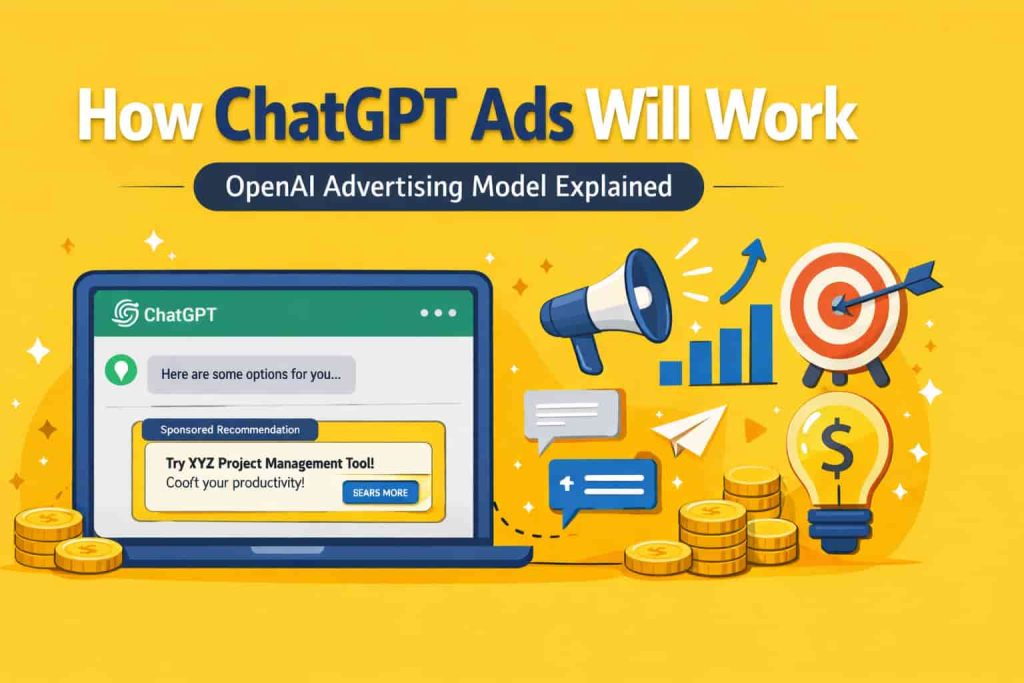
Here is how the format works when you see it. A user encounters a ChatGPT ad, clicks it, and then gets presented with an option to start a conversation with a business-sponsored agent. The conversation is clearly labeled as sponsored. It does not merge into the user’s existing ChatGPT thread, and it does not draw on ChatGPT’s general knowledge base in the way a normal prompt would. The user can ask follow-up questions, the agent can respond with information guided by the advertiser’s setup, and at some point the user can click a link that takes them to the advertiser’s website. The whole experience is contained within ChatGPT until that link is clicked.
The separation matters more than it might sound on paper. OpenAI explicitly states that the conversation with a sponsored agent is distinct from ChatGPT’s independent answers and separate from the original conversation the user was having before clicking the ad. That means the agent is not freelancing. It is not pulling from the general model the way your own ChatGPT chat pulls from everything it knows. It is operating within boundaries the advertiser helped define.
I picture this like a chat widget on a landing page, but one that loads before the user ever reaches the site. Most landing page widgets are ignored or closed within seconds. A sponsored agent inside ChatGPT forces engagement because the user initiated it by choosing to start the conversation after clicking the ad. The intent signal is stronger by definition. The user wants to know something.
Who controls the flow is the other piece worth noting. The advertiser remains in control of the conversational path and the links the agent can send. This is not OpenAI generating its own pitch about your product. It is your agent, your script, your destination URL. The platform provides the container. You provide the content.
According to the announcement documented by Seroundtable, the testing is limited to select US advertisers at this point. If you are outside that group, there is nothing to do yet except watch. The format itself is straightforward enough that when it does reach your account, the learning curve will be minimal. The hard part will be designing a conversation that actually moves people toward a conversion without feeling like a brochure with extra steps.
FAQ: How Do Sponsored Agents Actually Work?
What is a sponsored agent in ChatGPT ads? A sponsored agent is a business-controlled conversation flow that appears after a user clicks an ad. It is labeled as such and sits outside normal ChatGPT conversations.
Is the sponsored agent the same as ChatGPT’s free answers? No. OpenAI explicitly states it is distinct from ChatGPT’s independent responses and from the original conversation the user was having.
Who can use sponsored agents right now? Only select advertisers in the United States during the testing phase.
What does the advertiser control? The agent’s conversational flow and the links it can send users. The advertiser remains in control of the experience.
What It Means in Practice for Advertisers
Sponsored agents change the funnel. A click no longer dumps someone onto a landing page and hopes they convert. Instead, they get a guided conversation where they can explain what they actually need before being sent anywhere. That shift matters more than the usual platform feature list.
I think about it like this. When I run a small hosting business and someone clicks an ad for VPS plans, they usually have a dozen questions before committing: Can I migrate my current site? What happens if I need more RAM? Do you handle WordPress updates? If that person lands on a pricing table, they bounce. They have questions. They want to ask someone. With a sponsored agent, they can type those exact questions and get answers from your configured flow before clicking through to book a call or start a trial. The intent signal is stronger because the conversation surfaces it.
This format plays cleanly with the conversion optimization tools OpenAI already has in Ads Manager. Impression-billed campaigns optimize toward conversions from both clicks and views. Flexible attribution windows let you pick 7, 14, or 30 days for clicks and 0 or 1 day for views. When a sponsored agent conversation ends with a click to your site, that event feeds into the same optimization loop. You are not building a separate funnel. You are giving users a richer path to the same tracked outcome.
Text customization and AI-assisted ad creation pair naturally here too. The entire experience is conversational from top to bottom. Your ad copy introduces the topic. The sponsored agent carries the conversation forward. Your landing page closes the deal. Every touchpoint can speak the same language because you control it end to end.
The practical takeaway is simple. Start mapping the questions your ideal customer asks before buying. Not the ones you wish they asked. The real ones you hear on support tickets and in forum threads. Those are the questions your sponsored agent should answer first. Anything else is just decoration.
What to Expect Next
OpenAI has not announced a date for rolling Sponsored Agents out beyond the current US testing phase. The only signal I have is that international availability for the Shopify integration is planned for later this month. If OpenAI moves on a similar cadence, Sponsored Agents could reach a broader set of advertisers within the next couple of months. I do not know how this holds up once it scales beyond early testers.
I also expect OpenAI to keep expanding targeting granularity. Android app, Android web, desktop web, iOS app, and iOS web are already segmented in Ads Manager. It only makes sense that they will push further into device and platform-level controls as they collect more performance data.
The Event Quality Score update and the push toward impression-billed conversion campaigns tell me OpenAI is treating ChatGPT ads as a real performance channel, not an experimental one. Those features are not flashy. They are the kind of operational improvements that show up when a product team stops guessing and starts measuring. Sponsored Agents fit that same pattern. They are a way to capture more signal before the user leaves ChatGPT.
Here is what I would watch for over the next few weeks. First, whether OpenAI opens the Sponsored Agents test to more advertisers outside the US. Second, whether they add any new customization knobs around conversational flows, like question branching or dynamic product recommendations. Third, whether they start reporting conversation-level metrics in Ads Manager rather than just click-through and site conversion data.
If you run ChatGPT ads today, you do not need to wait for an announcement to start thinking about this format. Open the Tools > Conversions page and run Event Quality Score on your Pixel and Conversions API sources. Fix whatever it flags. When Sponsored Agents do reach your account, you want your conversion data already clean enough to feed impression-based optimization. A broken event setup now means broken optimization later. There is no shortcut around that.
Next Step: What You Should Do This Week
If you already run ChatGPT ads through the OpenAI Ads Manager, log in and check whether you see any reference to Sponsored Agents in your campaign creation flow. It will not be prominent. OpenAI is running this as a closed test, so most advertisers will not have access yet. But if you do, spend time mapping out the exact conversational flow before it goes live for your account. Write down every question the agent should ask, every answer it should give, and the single link it should send the user toward. I have seen too many advertisers launch conversational formats with twelve branching paths and zero clear next steps. It confuses users and kills conversion intent. Pick one outcome. One link. One question sequence.
If you do not have access yet, treat this week as preparation time. Open your CRM or lead capture tool and write out the top five questions your ideal customer asks before buying. These are the questions your sponsored agent needs to answer naturally. Keep them short. Write them in plain English, not marketing language. If your current sales calls follow a predictable script, that script is your agent’s backbone. Strip out the pleasantries. Keep the part where you diagnose the problem and offer the solution.
Audit your conversion tracking this week. Go to Tools > Conversions in Ads Manager and run Event Quality Score on every Pixel and Conversions API source you have connected. Fix whatever it flags. A low score usually means missing parameters, duplicate events, or incomplete user data passing back to OpenAI. Whatever the cause, fixing it now saves you headaches later. When Sponsored Agents roll out to your account and you start using impression-based optimization, your conversion data needs to be clean enough to feed the algorithm. Broken tracking now means broken optimization the moment the format reaches your campaigns.
Do not overcomplicate this. The advertisers who will win with Sponsored Agents are the ones who treat the conversation like a guided sales call, not a chatbot playground. Pick your link. Write your questions. Fix your tracking. Everything else waits.