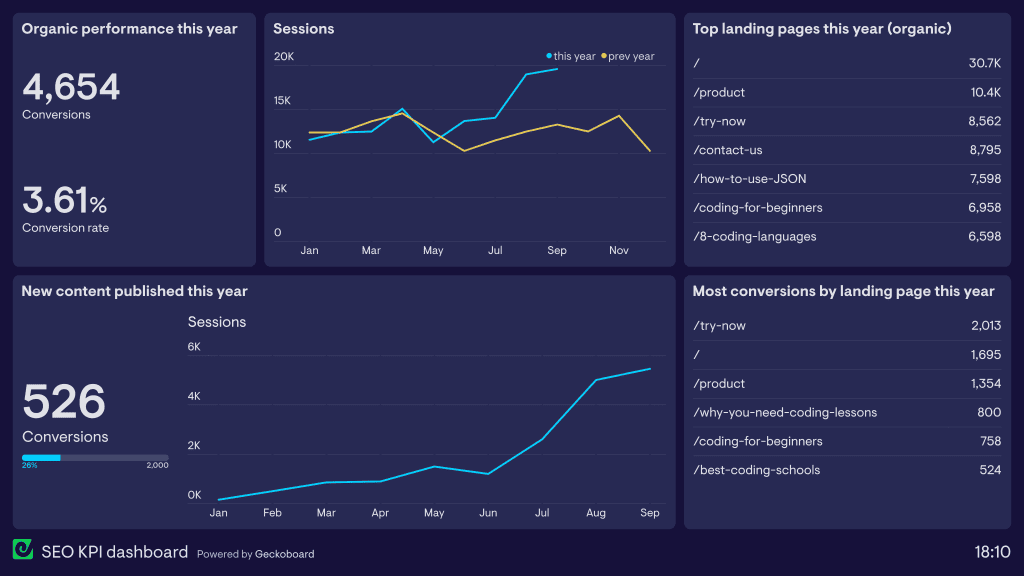
Eighteen metrics is a dashboard, not a strategy
Semrush published a guide that lists 18 SEO KPIs to measure organic and AI search performance (opens in new tab), and the honest first reaction to a list like that is to want all of them on one screen. I have built that screen. It looked impressive, it took an afternoon to wire up, and after two months I could not tell you what any single number on it was supposed to prove.
My position is simple. Three KPIs that ladder up to one goal will tell you more than twelve that each measure something real but point in different directions. Rankings, impressions, AI mentions, citations, referral visits from chatbots: none of those are fake metrics. They just answer different questions, and if you have not decided which question you are asking, twelve answers is worse than three because you will unconsciously pick whichever one looks best that month.
This is written for site owners and small operators who report to themselves, or to one person who signs off on the budget. If you have an SEO analyst on staff whose job is to watch the full set and surface anomalies, ignore most of what follows, because you have the labour to support a wide dashboard. Everyone else is choosing between a wide dashboard they skim and a narrow one they actually read.
There is a version of this problem I deal with on the hosting side every week. Netdata on a VPS exposes something like a thousand metrics per node. I do not look at a thousand metrics. I get paged on disk filling past a threshold and on backup jobs that exit non-zero, and everything else is a dashboard I open after something has already told me to look. Reporting on your own site works the same way. A handful of numbers earn the right to interrupt you. The rest are there for when one of those numbers moves and you need to work out why.
What are SEO KPIs?
SEO KPIs are the metrics across organic search and AI-generated answers that tell you whether you are on track toward your SEO goal and the business goal sitting above it. The common ones are search engine visibility, keyword rankings, AI citations, organic click-through rate, and conversions from organic traffic. That is the short definition, and it is worth holding onto the second half of it, because a metric only becomes a KPI once you can name the goal it reports on.
How many SEO KPIs should you track? Three, tied to one goal, reviewed on a fixed cadence. You can go to four if one of them is a conversion number that your stakeholder cares about independently. Past five and you are back to skimming.
The source frames KPIs as doing three specific jobs, and I think that framing is right:
- Tracking and evaluating performance over time
- Deciding where to put the next chunk of effort or money
- Showing ROI to whoever is paying for the work
That third one is the reason a KPI is different from a metric. A metric is anything you can measure. Time on page is a metric. Indexed page count is a metric. A KPI is the number you would put on a slide and defend when someone asks whether the last quarter of work was worth it. If you would not defend it, it is a diagnostic, and diagnostics belong in a drawer you open when something looks wrong.
The practical test I use: write the number down, then write the sentence you would say out loud about it. “Impressions on our commercial pages are up and clicks are flat, so the titles are the problem” is a KPI doing its job. “Bounce rate is 54%” is a number in search of an argument. If you cannot get from the metric to a decision in one sentence, it is not carrying its weight on your report, and it is quietly costing you attention that the other numbers need.
AI search added a whole new column
SEO reporting metrics used to sit on rankings, organic traffic, and conversions, and that was defensible for a long time because search results were the first touchpoint. AI-generated answers changed the order of operations for a lot of queries. The Semrush guide responds to that by splitting the AI side into three separate KPIs rather than one blob: AI visibility, AI mentions, and AI citations.
The distinction people get wrong is between the last two. A mention is your brand name appearing in the text of an AI answer. A citation is your domain being cited as a source for that answer. You can absolutely get one without the other. An answer can recommend your product by name while sourcing the claim from a review site, and it can cite your documentation page without ever naming your company in the visible text. If you are only counting one of them you have half a picture, and which half matters depends on whether you are selling a brand or selling a page.
Where these numbers come from in practice:
- Google Search Console impressions for overall search visibility. Performance, then Search results, then tick the box for Total impressions.
- Semrush Position Tracking for visibility on the specific keywords you chose. You enter your target keywords during project setup, and the Overview tab gives you a visibility trend plus an estimated ceiling.
- Semrush Visibility Overview for AI search visibility, mentions, and cited pages, broken down by platform and country. The Cited Pages number is clickable, which is the genuinely useful part, because it tells you which URLs are doing the work.
My caveat on AI visibility scores is that they are vendor-defined numbers on a 0 to 100 scale, derived from a sample of prompts that the vendor chose. I do not trust that the way I trust a GSC impression count, which is Google reporting on its own logs. As a trend line it is fine. As a target you are held to, it is weak, and I would not put a percentage-increase commitment against it in a client contract. AI citations tracking is in a similar spot: the underlying measurement is real, the stability of the definition is not yet proven.
Picking your three SEO KPIs
The selection rule runs top down. Write the business goal, pick the SEO goal that supports it, then choose the smallest set of KPIs that would visibly move if you actually achieved that SEO goal. If a number would stay flat even after a successful quarter, it is not a KPI for this goal, however interesting it is.
Three sets that cover most small sites:
Brand chasing awareness. Search engine visibility from GSC total impressions, AI mentions, and branded query impressions. You are measuring how many people encounter the name, so clicks are secondary here and conversions are noise.
Lead-generation site. Keyword rankings tracking on your money terms only (not the blog, not the glossary), organic click-through rate on those pages, and conversions from organic. Rankings tell you if you are visible, CTR tells you if the listing is persuasive, conversions tell you if the traffic was the right traffic.
New site with no history. Indexed page count, impressions, and the number of keywords sitting on page one. Conversions are useless as a KPI here because the sample is too small to read.
Total impressions in GSC is the easiest visibility number to get and the easiest to misread. It includes every query you appeared for, including ones you never targeted and ones you looked at and decided were irrelevant. I have watched impressions climb on a site while the commercial pages sat still, because one blog post picked up a long tail of queries with no purchase intent behind them. If impressions is one of your three, filter it or at least segment it by page group before you draw conclusions.
The unglamorous part is where the report lives and who reads it. Mine is a spreadsheet with one tab per month, fed by CSV exports, and it exists because a dashboard I have to log into is a dashboard I forget. On the hosting side I check a small set weekly and do a fuller pull at month end. Anything I only ever looked at during an outage or a panic was never a KPI, it was a diagnostic pretending to be one.
What to expect next
This part is my expectation rather than anything I can point to as fact. I expect the AI-side metrics to keep changing shape, because the platforms keep changing how and whether they show sources at all. If a provider redesigns its answer format and stops surfacing links in a given surface, your citation count can drop without anything about your site changing. That means your KPI definitions may not be stable year over year, which is an uncomfortable property for a number you are supposed to be trending against.
I also expect clicks and impressions to keep drifting apart. A falling organic click-through rate on a rising impression count is now a thing that needs interpreting rather than a straightforward failure. It can mean your listings are less appealing. It can also mean you are showing up for a wider set of queries where you were never going to be the click, or that the answer above you resolved the question. If CTR is one of your three, look at it per page group, not sitewide, or you will chase a sitewide average that no single page is responsible for.
What I would not do yet is rebuild reporting around AI citations as the primary KPI. The data collection is young, the sampling methods differ between vendors, and I cannot tell you how any of it holds up over a window long enough to matter. I am tracking it. I am not making decisions on it alone, and I would push back on an agency that put it at the top of a report this year.
The other fifteen KPIs from the source list keep their value as diagnostics. When your CTR drops, that is when you go look at position distribution, SERP features, and which pages lost ground. Reach for them in response to movement, not on a schedule.
Cut the list this week
Open your analytics tab and delete things. Write your business goal in one sentence, write the SEO goal underneath it, pick your three KPIs, and remove everything else from the view you look at regularly. The removed metrics still exist in the tool. You are just no longer paying attention tax on them.
Then set the baseline today, because a KPI with no starting point is a number you cannot argue with. Export GSC impressions and clicks for the last 90 days as CSV, note the current position of your top 10 keywords, and record your current AI mention count with the date you pulled it. Put those in one file. Mine is a spreadsheet named search-baseline.xlsx and it is not pretty.
Book a recurring 20-minute slot for the weekly check and a longer one at month end for the fuller pull. Then leave the KPI set alone for a full quarter. A KPI you swap every three weeks is measuring your mood, not your site.