Intro
If you have been watching your rankings all September, you know exactly how disorienting this month has been. Google search ranking volatility September 2026 has hit publishers from multiple directions at once, and the kind of data chaos showing up in Google Search Console makes it nearly impossible to separate cause from coincidence. That combination is what this post is about.
The Search Engine Roundtable covered the timeline in detail last week, documenting how a September 4th update appeared to roll back around September 13th before rankings spiked upward again around September 15th. That two-wave pattern does not fit the usual core update model. Whatever Google pushed out on the 4th was interrupted, possibly by an internal rollback, and then something else pushed rankings sharply higher by the middle of the month. The roundtable discussion noted this odd sequencing clearly Search News Buzz Video Recap (opens in new tab).
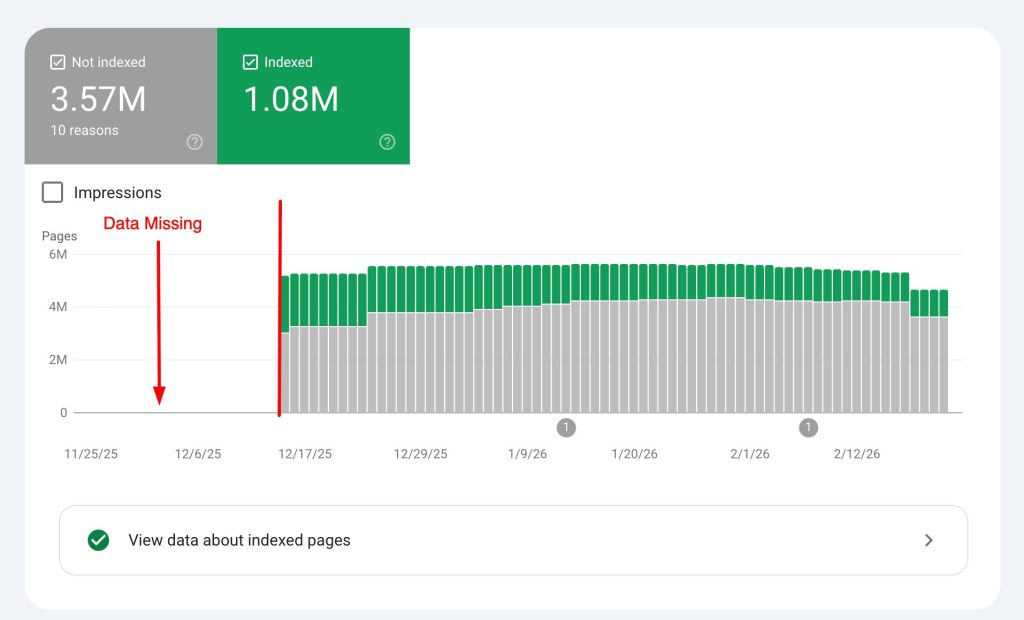
Here is the frustrating part. While your rankings have been bouncing around, Google Search Console has developed its own problem. The page indexing report is missing a chunk of data from June 2026, which means you cannot easily trace indexing trends backward through the exact window when these updates occurred. On my own boxes, I have watched the indexing tab show gaps where several months of historical records should be sitting. It looks like a corrupted export, but it is not your fault.
These are not separate issues. When rank fluctuations intensify and your primary diagnostics tool goes blind at the same time, you need a framework for coping rather than pretending one explains the other. I have seen site owners panic over ranking drops during volatile weeks, only to realize later that their Search Console data had been incomplete for days. The missing June window compounds that problem because it overlaps with a stretch of active search changes.
What follows is a breakdown of what happened with the September updates, why Search Console looks broken right now, and what practical steps you can take this week to get visibility back. The tone is analytical rather than reassuring, because these situations rarely offer clean explanations. Publishers who treat Search Console as just another signal in a larger toolkit tend to navigate periods like this better than those who depend on a single dashboard.
Background
Google’s September 2026 volatility did not arrive as a single event. It arrived in waves, and that pattern is what makes it harder to diagnose. On September 4th, Google pushed out what the community immediately identified as a significant update. Sites reported ranking shifts across a broad set of queries, and for several days the data was messy but understandable. Then around September 13th, that update appeared to roll back. Rankings moved again, often in the opposite direction, which left many site owners watching their traffic charts look like an EKG reading during an arrhythmia episode.
I have watched this kind of two-wave pattern before, and it is almost always more disorienting than a clean core update. With a single update you can draw a line through your data and say, here is the drop, here is the recovery. With a rollout and a partial reversal, you end up with overlapping signal and noise that resist simple attribution. The September 15th spike on top of that confusion made the picture even murkier. Rankings surged upward in many cases, suggesting something beyond a standard algorithmic adjustment was at work. Barry Schwartz covered the timeline extensively in his Search Video Recaps (opens in new tab), and the community consensus has been that Google was running through at least one major update and one partial rollback within a twelve-day window.
This is also the period where Google’s infrastructure changes are becoming visible. AI Mode is testing text link ads, which introduces a new monetization format that can shift how listings appear on the results page without any algorithmic ranking change. Meanwhile, Gemini 3.8 Live now powers Google Search Live, which means the way Google assembles and presents certain query results is being rerouted through a different system entirely. When both of those shifts happen during a volatility window, it becomes nearly impossible to tell whether a ranking movement came from an algorithm update, a layout change, or an AI-mode experiment.
The practical effect for publishers is that the September events cannot be treated as a standard SEO incident. They overlap with product experiments, infrastructure swaps, and what Google itself has called an unusual volatility pattern. Understanding the background means accepting that the usual diagnostic framework does not apply cleanly here.
What’s Happening Now with Google Search Console Indexing Report Missing Data
If you have tried to pull the page indexing report in Google Search Console recently, you have probably noticed the gap. The data from June 2026 simply does not appear. Where there should be a steady stream of indexed and excluded pages, there is now a blank stretch that makes it impossible to track trends across one of the most volatile periods in recent search history. I understand why this feels frustrating when you are already trying to make sense of the September ranking chaos. It compounds the confusion rather than helping.
Google has confirmed this is a known issue. The company told the community through the Search Roundtable video recap on September 18th that the indexing report is currently missing a portion of historical data from June, and they have not provided a timeline for when the gap will close Search News Buzz Video Recap (opens in new tab). More importantly, Google also stated that position reporting in the Performance report may evolve over time, which signals that even the data you can see today could look different in future interface updates.
The missing June window matters because it overlaps directly with the September 4th update and its partial rollback around September 13th. If your rankings dropped during that period, you currently cannot cross-reference the timing against crawl activity or index coverage changes inside Search Console. That is like trying to figure out why your car stalled without being able to read the dashboard. You can listen to the engine, check the fuel gauge manually, and look at the road conditions, but the instrument cluster that would normally tell you exactly what happened is dark.
This reporting gap arrives at a time when Google is actively shifting diagnostic weight toward other products. The Chrome User Experience Report now includes four new ad metrics, which pulls some measurement focus away from Search Console and into Chrome-related tooling. At the same time, Google is experimenting with AI-driven position reporting and expanding its AI contribution pilot, both of which operate outside the traditional Search Console framework. The net effect is a diagnostics landscape that is fragmenting rather than consolidating.
I expect Search Console position reporting to continue evolving in unpredictable ways rather than settling into a stable format. That does not mean the tool is failing. It means Google is rebuilding how ranking data gets collected and presented while simultaneously running algorithm updates, AI experiments, and infrastructure swaps. When all of those layers change at once, losing six weeks of historical indexing data feels heavier than it normally would.
The most practical thing you can do right now is export whatever indexing and performance data you still have access to from before the June gap, save it locally, and archive it alongside your Analytics exports. Once the missing data window either fills in or shifts permanently, having that baseline saved will let you compare the volatility period against something tangible rather than working from memory.
What It Means in Practice for Publishers and Site Owners
When ranking volatility hits and your Search Console looks blind at the same time, you are essentially flying without instruments. The September 4th update rolled back around September 13th, then rankings spiked again on September 15th, which created a two-wave disruption pattern that made it nearly impossible to pin down what actually happened to your traffic. Losing the indexing data from June compounds that problem because you cannot easily correlate those rank swings with crawl or indexation changes when half your historical records are gone.
I have seen site owners scramble to cross-reference GA4 sessions against known volatility dates because Search Console simply could not provide the correlation they needed. The missing June window overlaps directly with active update activity, so if your pages took a hit from the September 4th shift or its later reversal, you may not have the indexing trail needed to prove it inside the tool.
The fragmentation is real. Google is adding ad metrics to Chrome UX Report, running an AI contribution pilot that pays publishers for content used in Gemini and AI Overviews, and testing AI Mode text link ads. All of these pull measurement away from the centralized Search Console view most publishers rely on. If your content gets pulled into an AI Overview response during one of these volatility windows, traditional ranking metrics will not show you the full picture of what happened to your traffic.
Consider a small business site that serves local services. Its organic traffic drops sharply around mid-September, but Search Console shows nothing in the indexing report to explain why. Meanwhile, the site owner’s content might have been cited in an AI Overview generated by Gemini, which routes users differently than a standard blue link. That traffic shift would never show up as a ranking change in Performance. It would look like a mystery drop instead.
Google’s AI contribution pilot adds another layer on top of this. If your pages are being drawn into AI responses during these fluctuation periods, the traffic you receive may not map cleanly onto position tracking anymore. You could see impressions or clicks move without any visible ranking shift, and Search Console position reporting will not catch that nuance.
Cross-referencing multiple data sources is no longer optional. The single-report approach that worked two years ago is breaking apart as Google distributes diagnostics across Chrome UX, AI pilot dashboards, and evolving Search Console features. Publishers who only check one tool will miss what is actually happening during volatility events like September 2026.
What to Expect Next
Search Console’s position reporting will not stabilize into a permanent setup. Google has been explicit that changes are coming, and the missing indexing data for June is likely just one visible symptom of a broader architectural shift. Expect periodic reworkings of how ranking positions are calculated, displayed, and made available to publishers. The tool will still exist, but the way you interact with it inside the Performance report will change more often than it has in recent years.
Google’s ad tech monopoly remedies are moving toward behavioral changes under oversight rather than structural breakups. That distinction matters because behavioral remedies tend to reshape how ads appear and perform within search results over time. Publishers should watch for adjustments to how ad-related metrics surface across Google’s products. If Search Console continues to lose ground as the central diagnostics hub, ad performance data may migrate to other interfaces or require separate monitoring entirely.
The Chrome User Experience Report’s four new ad metrics reinforce this direction. Google is clearly distributing measurement responsibilities across multiple products instead of concentrating everything inside Search Console. That fragmentation will become more pronounced, not less. You will likely need to monitor CrUX for ad-related signals, Search Console for indexing and crawl data, and potentially other dashboards for content attribution through the AI contribution pilot.
Google Search profiles now support badges and have simplified account management. These seem like minor interface updates, but they align with a larger push around publisher identity and content attribution. If the AI contribution pilot expands, badges and profile features may become the primary mechanism for linking your content back to your property inside Gemini and AI Overview citations. This is still speculative, but the pieces are moving in that direction.
One concrete expectation I hold is that Google will continue to phase out centralized position reporting in favor of distributed, context-specific metrics. The Performance report’s position column may become less reliable or less frequently updated as the company shifts attention toward AI-driven insights and ad-aligned measurements. This is not a prediction based on insider knowledge. It is an inference from the pattern of announcements across September 2026.
The practical takeaway is straightforward. Export your current Search Console data now before any further gaps or interface changes make historical comparison impossible. Save indexing reports, performance summaries, and any custom date ranges you rely on. Then decide which two or three alternative tools you will monitor regularly. Cross-referencing is the new normal, and waiting until the next volatility event to figure that out is a risky move.
What to Do This Week
You have about five days before another update wave hits and another piece of data disappears from your reporting tools. The practical work is not complicated, but it does require moving faster than your usual cadence.
Start with Search Console. Navigate to the Indexing report and export the page indexing data for every valid date range you can pull. Focus on the gap itself. Whatever data exists for the period running from early June through early September matters most right now. Save those exports as CSV files with dates in the filenames so you can sort and compare them later. Do this first because once Google patches the missing data or rotates the report out, those records may become harder to access.
Next, open your Google Analytics property and pull traffic trends from June through September 15th. Look for the two disruption points I covered earlier. The September 4th update window and the September 15th spike should show up as inflection markers in your organic traffic graphs. If your site dropped sharply around early September and recovered near the 15th, that pattern matches the volatility story from the Search Engine Roundtable recap Source (opens in new tab). Write down the dates and the magnitude of the shifts. You will need that baseline when you cannot pull Search Console data for the same window.
Check whether your content shows up in AI Overviews or Gemini citations. This is no longer optional. Google’s AI contribution pilot is paying publishers for content used in Gemini and AI Mode, which means traditional ranking metrics are only measuring part of the picture. If you have an active site, spend thirty minutes searching for core topics you publish on and see if your pages appear in AI-generated responses. Note which domains are visible and which are not. This gives you a signal that Search Console simply cannot provide right now.
If you run any paid campaigns, sign up for the Google Ads spend benchmark report. It is free and it compares your spend against competitors in your vertical. With Search Console position data fragmenting and CrUX absorbing ad metrics into a different product, having competitive spend context in a separate dashboard fills a real gap.
The final action is also the simplest. Pick two alternative data sources you will check weekly from here on out. I recommend Google Analytics combined with either the new Chrome UX Report ad metrics or a third-party rank tracker that pulls raw SERP positions. One source is too fragile given what happened this month. Two gives you redundancy. Set calendar reminders for every Monday morning to pull those reports before the volatility of the week ahead clouds your judgment.