Intro
You just entered your password. You picked the right OTP code from your authenticator app. The green banner flashed. You are in. Then, two minutes later, your customer service team notices a session ending with a user in the admin group that was not you. This is not a password breach. This is what happens when an adversary sits between you and the login page, waiting for you to complete your MFA.
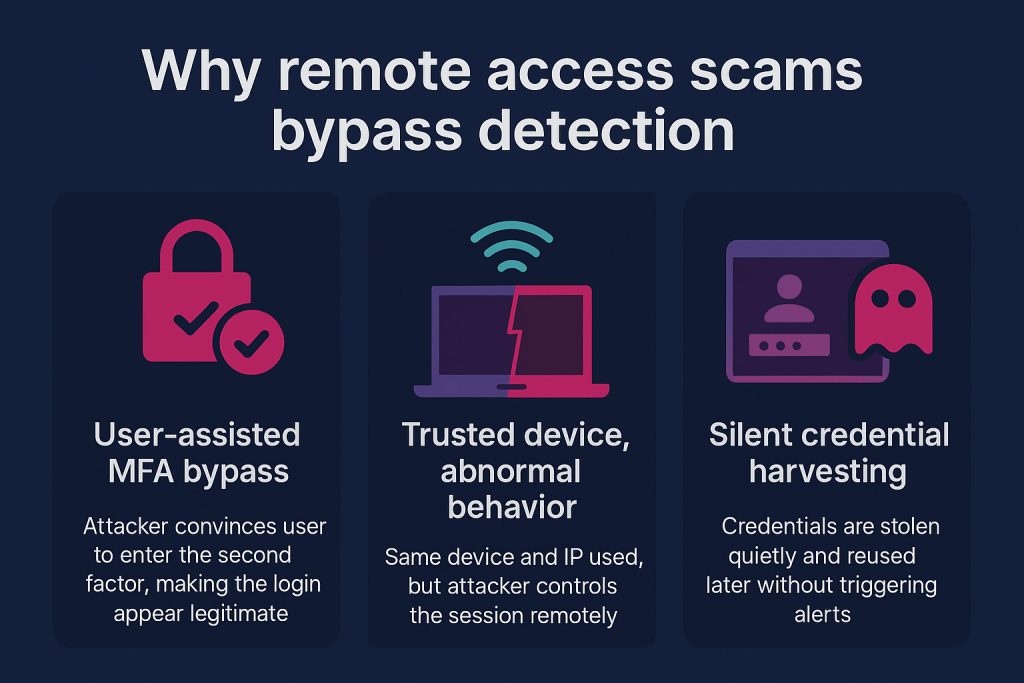
MFA bypass techniques have evolved past the point where a strong password and a second factor actually stop a determined attacker. The failure point is no longer the credential entry; it is the session handoff. In an Adversary-In-The-Middle attack, the attacker does not steal your password. They steal the valid session cookie generated after your MFA check. To the service, that cookie is indistinguishable from yours. The trust model breaks not because the password was weak, but because the session is treated as a static token that persists long after the initial authentication.
SpyCloud recently published their 2027 Forecast Report (opens in new tab), which flags this exact shift. They predict that attackers will prioritize vectors organizations already trust, specifically active sessions and vendor connections, over brute-force password attacks. While I take vendor forecasts with a grain of salt, the underlying signal is clear: the industry is acknowledging that MFA alone is no longer a boundary. It is a checkpoint that can be bypassed in transit.
This post is not about writing better phishing filters. You likely already have some form of email screening. This is about the session hijacking that happens after the click. If you have ever managed a VPS or a shared hosting environment, you know the pain of a compromised root shell that persists even after you change the user password. That is the same logic applied to SaaS and enterprise identities. The access token is the root shell.
For site owners and developers, this means the “I changed my password” remediation step is often insufficient. If an attacker holds a valid session or an API key, changing the password does not always kill the active connection. We need to look at session integrity, token revocation, and the specific ways third-party agents are expanding their blast radius. The threat is not that MFA is dead. It is that MFA is being outmaneuvered by attacks that target the trusted state after MFA succeeds.
Background: The Evolution of MFA Bypass Techniques
To understand why the landscape is shifting, you have to look at how the attack vectors have changed over the last five years. The days of simple password spraying are mostly behind us for anything remotely secure, but that has not made systems safer. It has just forced adversaries to get cleverer. The primary technique that killed the “password is the gate” mindset is the Adversary-In-The-Middle (AiTM) attack. In plain terms, an attacker sets up a proxy site that looks exactly like your login page. You think you are talking to Microsoft or GitHub. You are actually talking to the attacker.
Here is the mechanics. The attacker’s site passes your username and password to the real provider. The provider sends an MFA prompt. The attacker’s site now shows that MFA prompt to you. You enter the code on your phone. The attacker forwards that code to the real provider. The provider grants a valid session token. The attacker hands that token to you. Your browser stores it. You are logged in securely, thinking you just did a normal login. The attacker now also holds a valid, MFA-verified session token for your account. No password is stored. No MFA device was compromised. The session is simply hijacked in transit. This is why changing your password does not fix it. The token remains valid until it expires or you explicitly revoke it.
A more aggressive variation is the Browser-In-The-Middle (BitM) attack. Instead of a fake website, the attacker uses malware to intercept the authentication flow directly inside your browser. They hook into the browser’s network stack, capturing the session cookies as they are issued. This is harder to deploy because it requires the victim to run malicious code, but when it works, it is nearly impossible for the user to detect. They see no phishing page. They see their normal browser. The capture happens silently in the background.
This evolution matters because it shifts the trust model. Organizations used to trust the credential. Now, they must trust the session. But the problem is that most organizations have built their integrations on the assumption that the credential is the only thing that needs guarding. We grant long-lived admin scopes to vendor integrations that nobody audits. A Slack app that was approved three years ago for a single feature might still hold the permission to read every private channel. A CI/CD pipeline key generated for a legacy project might still have write access to production secrets. These are not user accounts. They are non-human identities (NHI). Traditional MFA strategies do not cover them because these entities do not log in with a username and password. They do not answer to a TOTP app. They just hold a key that was issued once and never rotated.
This is the blind spot. While we are all busy worrying about phished passwords, we are leaving the doors wide open for the service accounts that connect our SaaS platforms. The threat is not that MFA is broken. It is that MFA is only applied to humans, while the machines we trust have no second factor at all.
What’s Happening Now: From WardenStealer to AI Agents
The theory behind MFA bypass techniques has moved from forum discussions into the wild. Commodity malware is now explicitly designed to harvest the tokens that keep AI tools running. Two specific infostealers, WardenStealer and Aoki, have shifted their focus away from just grabbing browser cookies and passwords. They now target the API keys, OAuth tokens, and session files that developers use for AI coding assistants and autonomous agents. On a developer’s machine, this looks like a harmless background process until you check the application data folder and find files you did not create.
The scale of this problem is becoming hard to ignore. SpyCloud reported recapturing more than 127,000 WardenStealer infections since August. That is not a niche threat targeting a few sophisticated attackers. It is a volume-based operation. When an infostealer is deployed, it does not just steal the password for your GitHub account. It scans for the id_rsa key, the AWS CLI config, and the local storage directories for AI development environments. If you use an AI agent that reads your local repository to generate code, that agent holds credentials that can push code to production, query your database, or spin up cloud instances. A password reset on your primary email does nothing to invalidate those stolen API keys. They remain active until you manually revoke them in the provider’s dashboard.
A concrete example helps illustrate the danger. Imagine a mid-sized e-commerce site that integrates an AI agent to automatically fix linting errors in their Python codebase. The developer grants this agent a service account with full read access to the source code and write access to the staging environment. The agent works quietly in the background. One day, the developer’s laptop is hit with Aoki malware. The malware exfiltrates the agent’s token. The attacker now has the same access as that AI agent. They can read the source code, see the database connection strings, and test code in staging. The MFA on the developer’s personal account is irrelevant. The attacker is not logging in as the developer. They are logging in as the agent.
This is where AI agent security gets messy. We are beginning to see malicious skills appear on AI marketplaces. These are plug-ins that look legitimate but contain prompts designed to trick the agent into executing shell commands or downloading additional payloads. It is a new vector because the agent trusts the skill by default. It does not have the critical thinking to question why a “weather reporting” skill needs access to the system’s root directory.
I expect this to accelerate over the next year. The line between a user account and a machine identity is blurring. For now, the practical takeaway is that your MFA protects the human, but it does not protect the machine. If your AI tools hold long-lived credentials, you are effectively handing attackers a backdoor that does not require them to guess a password. The session is the new credential, and it is currently unguarded.
For more details on these emerging threats, see SpyCloud’s 2027 Forecast (opens in new tab), which tracks the shift toward trusted access exploitation.
What It Means in Practice: Questions You Should Be Asking
Most teams think about MFA bypass techniques in terms of stopping the phishing email. They train staff to spot typos in sender domains and install email gateways that filter out obvious scams. That is necessary, but it is no longer sufficient. The actual risk now sits in the gap between a valid login and what the attacker does with that validity. I have seen this play out in my own hosting environments where a compromised SaaS integration held a service token with broad read permissions for two years. Nobody audited that token because it was “just for the CRM plugin.” When the vendor got breached, the attacker did not need to break into our main domain. They simply rotated the compromised token into a new session and walked through the back door.
This brings us to a core operational question: how does your team currently validate that a valid token is actually legitimate? Many systems treat a token as proof of identity. If the token matches the signature, the request goes through. But that assumes the token was not stolen five minutes ago. You need session integrity checks that look at device fingerprinting, IP geolocation drift, and behavioral baselines. Without that, a stolen token looks exactly like a legitimate one to your API gateway.
Second, look at your vendor integrations. Where do they hold admin scope, and when was that last reviewed? In the SpyCloud report (opens in new tab), researchers noted that 68% of security professionals have dealt with a breach via a third party. That number is not just about data loss. It is about trust inheritance. If you give a marketing automation tool admin rights to your identity provider, you are giving the marketing tool’s developers access to your entire organizational structure. That is a massive third-party risk management failure waiting to happen.
Then there is the AI agent question. Do you have visibility into which AI agents are reading your internal logs and tickets unattended? If you have plugged a large language model into your Jira or Slack channels, that model now has context on your internal vulnerabilities. It reads error logs that contain stack traces with database names. It reads chat messages where engineers discuss architecture. If that agent is exposed to a prompt injection attack, or if its service account is compromised, the attacker gains context that was previously locked behind strict access controls.
Finally, accept this uncomfortable operational reality: a password reset does not invalidate stolen AI access. If an attacker has already captured a long-lived API key or a service account credential for an AI tool, resetting the human user’s password does nothing. The non-human identity persists. You must manually revoke and rotate those tokens. Most teams do not know which tokens exist, let alone how to revoke them quickly. That blind spot is where the breach actually sticks.
I expect the next wave of incidents to be traced back not to a cracked password, but to a forgotten API key that was granted three years ago for a project that no longer exists. The credential is still active. The project is gone. The access remains.
What to Expect Next: The Next 12 Months
I am not going to tell you that autonomous AI attacks will take over the world next year. The SpyCloud report explicitly rates that specific prediction as low-confidence, and for good reason. Fully autonomous attacks have not shown up in their recaptured data yet. What is coming is something less cinematic but far more damaging: ordinary attacks running faster, cheaper, and on infrastructure we already trust.
Expect the chatter from cybercriminals to move off public forums entirely. As takedowns continue, groups are hopping to free, feature-rich chat apps, and soon to invite-only platforms like Session, SimpleX, or Matrix. This shift matters for defenders because it changes how we monitor threat intelligence. You can no longer scrape a public forum for IOCs in real time. The conversations about new exploit kits or zero-days will happen in encrypted, closed groups where the invite is the only gate. I anticipate a significant lag between when a technique is discussed in those circles and when it hits the wild, which makes proactive hardening even more critical than reactive patching.
We will also see a surge in synthetic identities. Fraudsters are already stitching together convincing personas from stolen real data and AI-generated faces and voices. In the next twelve months, expect these identities to open accounts at volume using AI agents to automate the onboarding process. The 2026 survey showed only 6% of respondents have seen this activity yet. That number is going to climb fast. The line between a legitimate new user and a synthetic fraud account will blur until your identity verification systems explicitly test for AI-generated artifacts.
There is also a growing blur between the negligent insider and the malicious insider. As employees lean on AI copilots for daily tasks, the security boundary around human actions expands. An employee using an unapproved AI tool to summarize an email containing sensitive client data is an insider threat, even if they did not mean to leak it. The distinction between “user error” and “malicious exfiltration” is becoming harder to draw when the tool doing the copying is an agent, not a person.
My expectation for the next year is not that AI will launch the attacks. It is that AI will strip out the friction from the human steps, allowing smaller, less sophisticated groups to execute complex social engineering campaigns at a scale that previously required a large nation-state budget. The damage will come from the trusted connections we ignore, not from the new, shiny vulnerabilities we fear.
Audit Your Non-Human Identities
The first practical step you can take today is to stop assuming your access control lists are accurate. They are not. Here is the specific audit I recommend:
- List every non-human identity. Go through your cloud provider console (AWS IAM, GCP Service Accounts, OCI Dynamic Groups) and your SaaS dashboards. List every service account, API key, and AI agent token currently active. Include the tools you connected six months ago for a POC that never shipped.
- Run a revocation test. Pick one test token that you suspect is not being used. Revoke it in the source system. Then check your application caches. Does the session persist? If the application keeps working with the revoked token, you have a serious caching vulnerability that will fail during a real incident.
- Move to short-lived credentials. For all third-party connections, stop using long-lived static API keys. Implement short-lived tokens with automatic rotation. This reduces the blast radius if a leak occurs. A stolen key that expires in fifteen minutes is nearly useless to an attacker.
Start that list this week. The items on it will surprise you.
Concrete Next Step: Audit Your Non-Human Identities
You know the feeling when you open a folder you have not touched in two years and find files you completely forgot existed. Your identity infrastructure is likely in the same state. The most effective way to reduce your exposure to MFA bypass techniques is not to buy another point solution. It is to look at the things you already gave access to, because that is where the attackers are winning.
Start by building a list of every non-human identity (NHI) in your environment. This includes service accounts, API keys, OAuth tokens for CI/CD pipelines, and the credentials for any AI agents you have connected to your internal systems. Do not rely on your cloud provider’s default dashboard view, which often hides stale resources. Query your AWS IAM, GCP Service Accounts, or OCI Identity Domains directly for resources that have not had activity in the last ninety days. If you cannot identify who created a specific API key or why a service account still holds admin permissions, it belongs on the deletion list. I once found an integration key for a marketing automation tool that had been decommissioned three years earlier. It still had write access to our production database. It was not a sophisticated vulnerability; it was just negligence that persisted.
Next, perform a simple revocation test. Pick a low-impact, test-environment token. Revoke it in the source identity provider. Then, immediately check your application’s session cache. If the application continues to accept requests using that revoked token, your caching layer is bypassing the central authority. This is a critical failure point. In a real attack, an adversary holding a stolen session will not stop just because you rotated the secret. If your cache holds onto the old value for thirty minutes, that is thirty minutes of free access for the attacker. Force a cache flush on revocation and verify it manually.
Finally, transition third-party integrations to short-lived credentials. Static API keys that remain valid for years create a massive blast radius if a single infostealer harvests them. Implement automatic rotation with tokens that expire in fifteen to thirty minutes. This means that if a credential leaks, its value drops to near zero almost immediately. The friction of rotation is worth the security gain.
Begin this audit today. The goal is not to achieve perfection overnight, but to stop the silent accumulation of unused, over-privileged connections that are waiting to be exploited.